


25/Sep/2026
5 min read


‘RRR’ is as anti-colonial as the navel-gazing “pure vegetarian” character of Raja Puran Singh in ‘Lagaan’ was anti-colonial.
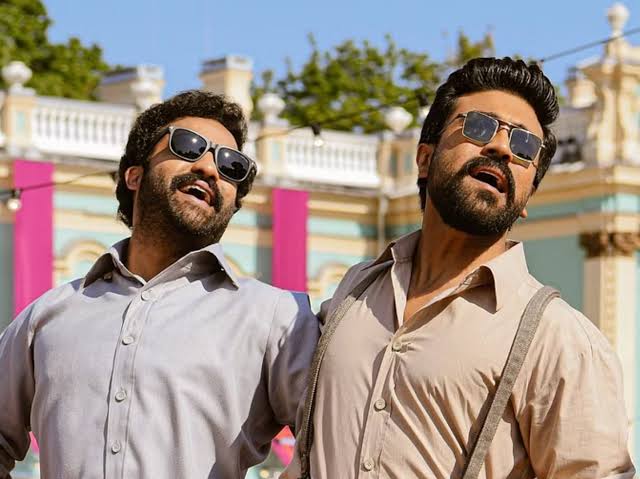
A still from the ‘Naatu Naatu’ music video.
Like many music lovers, I revel in listening to a newly favourite song over and over again. So when I first discovered RRR’s ‘Naatu Naatu’, for a long stretch of months it was the one song which boomed constantly into my earphones week after week. Apart from being an excellent aural treat, ‘Naatu Naatu’ is a spectacular visual riot. I like it when videos of film songs feature an engaging plot in themselves, and as a delightfully choreographed narrative within the larger story of its film, ‘Naatu Naatu’ is eminently watchable as well as danceable.
The song was also performed at the 2023 Academy Awards ceremony, where they said that it illustrated RRR’s “anti-colonialist themes”. In the film, ‘Naatu Naatu’ features a British officer in 1920s Delhi mocking and racially abusing an Indian man, claiming that “these brown buggers” know nothing about “art, finesse, dance”. The man and his friend respond to this abuse by performing “desi naach” (featuring the above-mentioned spectacular choreography) and prove to the assembled colonisers that the colonised can dance – that too astonishingly well.PlayNextMute

In the confined context of the party at an elite colonial club which forms the backdrop for the song, this foot-tapping resistance by the two Indian men can perhaps well be termed “anti-colonialist”, more so if we ignore the simplistic, almost comic binary categories, exaggerations, and gendered assumptions interspersed throughout the song’s narrative. But when we zoom out of the giddying ‘Naatu Naatu’ moment and take stock of the whole of RRR, it becomes increasingly difficult to think of it as an anti-colonial story or to ignore its serious and pervasive flaws, some of them pretty revolting as several reviewers noted long back (see, for instance, here, here, and here).
I sat down to watch RRR around a year after its release, following months of being bombarded by the relentless publicity about it. My excitement, however, lasted as long as the duration of meaningful screen time women characters get in the film. Within the first 10 minutes itself came a protracted and painfully absurd action sequence in which the character of Raju plunges in a massive mob of hundreds of angry people to nab one of them for his British superiors. It turned out that such overstretched action sequences, often with stupendously ridiculous elements, formed the backbone of RRR, supplemented by a near-juvenile storyline full of convenient accidents and coincidences.
Not that RRR is unenjoyable – there are indeed genuine moments of thrill and brilliant spectacle throughout. In fact it is the combination of absurdity and spectacle that seems to have won RRR countless fans. Which is all well and good, and pretty unremarkable news for folks of my generation who remember the unexpected but concrete global popularity of the absurdly delightful songs Why This Kolaveri Di and Gangnam Style. But the craze around RRR was often accompanied by discussions and debates on real-world topics, especially the history of British colonialism in South Asia, and in many circles RRR managed to somehow assume the mantle of a new-age anti-colonial film. Unfortunately, however, RRR is as anti-colonial as the navel-gazing “pure vegetarian” character of Raja Puran Singh in Lagaan was anti-colonial.
To begin with, the primary intentions of the two protagonists in RRR are too parochial to be meaningfully categorised as anti-colonial. The character of Raju/Ram – shown constantly sporting the torso thread that marks elite caste males – is so arrogantly convinced of the validity and superiority of his own narrow goals, that he displays no sense of introspection or empathy as he goes about mercilessly assaulting and crushing his own fellow Indians in a supposedly noble and “anti-colonial” pursuit. What is more, the film then goes on to claim that his objective, with its cryptic and self-obsessed approach and “collateral damage”, is not just laudable, but also more significant than the “simple” one of the other protagonist Bheem. An Adivasi, Bheem is focused on rescuing from captivity a child of his clan, and seems to refrain from harming innocent people to achieve his goal. In fact, such clear hierarchies and binaries (e.g., simple-complex, primitive-civilised, unlettered-learned) are a central feature not of anti-colonialism but of colonialism and its accompanying Orientalism – as well as of the centuries-old caste system of the subcontinent.
Advertisement
RRR’s “anti-colonial” credentials are further weakened by its extensive use of tropes and symbols which are of the Hindu nationalist, not Indian nationalist, variety. The movie prominently features a religious figure – the god Ram – and this popular deity’s portrayal in it is more in alignment with how contemporary Hindu nationalists imagine him, rather than, say, how the prominent anti-colonial leader Mohandas Gandhi imagined and depicted him. Of course, RRR is not the first film of director S.S. Rajamouli in which a righteous male protagonist and a Hindu deity are projected as almost one and the same to an enthralled audience. In his other global hit, Baahubali, we were expected to think of the character of Shiva (in the Hindi version) as almost an incarnation of the god Shiv (or Shiva/Shankar).
The phenomenon of creatively portraying Hindu deities, especially those which are part of the elite Brahmanical pantheon – different from the imposing variety of hundreds of divine figures patronised by Bahujan communities, like the Maharashtrian Jotiba and Khandoba which were my own family’s primary deities – dates back to Indian cinema’s earliest years, which film scholars describe as dominated by stories based in religion and religious mythology. This early 20th century obsession with Brahminical religious symbolism, though it never completely disappeared from mainstream Indian cinema, has over time given way to a tremendous diversity of stories and narratives. So in the 21st century when a Rajamouli film with almost impeccable CGI and world-class stunts still regurgitates some of those same dated storylines, one can’t help but exasperatedly remember historian Meera Nanda’s acute observation that (in paraphrased words) for a large number of especially privileged-caste Hindus, being “modern” has simply meant being religious and upholding caste-based worldviews in newer, fancier, more hi-tech ways. After all, even in the domain of animated films, most of the popular Indian ones have been based on themes drawn from Hindu religious mythology.
Finally, RRR is too lacklustre in terms of substantive content to be taken seriously as anything other than simply optic entertainment. As reviewer Tanul Thakur noted, the movie starts with an Adivasi group’s valiant efforts to find and rescue a girl and sets the stage for intricate and engrossing “detective flair”: but it ends up offering none of that, with the whole plot moving forward simply “through coincidences and heroism”. For all its epic visual spectacle, RRR has no memorable line or quip or conversational segment, and is devoid of humour altogether (despite some insipid and dated comedic manoeuvrers like the character of Akhtar mispronouncing the name of the Governor’s niece). There were several reviews of RRR which, even as they lavishly praised its action and direction, noted its “cartoonish” and “cartoonishly evil” villains, and how it offered “neither psychology nor history nor social context” to enrich its narrative. RRR can be compared to the bombastic speeches of charismatic talkers (or bol-bachchans): the rhetoric has no real substance but is so well packaged and delivered that the audience is swept up and fully captivated, at least for the duration of the speech. As one reviewer articulately wrote: “It’s all presented in such visually dazzling fashion that your eyes are fully satisfied before your brain can make any objections.”
Can a Rajamouli film ever feature complex historical and sociopolitical elements and capture their nuances, while at the same time providing blockbuster entertainment – like, say, PK or Haider did, or the stand-up acts of brave Indian comedians today do? For now I am sceptical, especially after reading a New Yorker interview wherein Rajamouli’s comments on Indian history, society and politics weren’t all that inspiring.
But despite my scepticism, I do wish to see Rajamouli working on something that is truly, radically political. There is no denying his enormous creative talent and imaginative prowess. If those skills are used to tell a powerful story which, for example, features the bravehearts who have constantly rallied against new and old forms of colonialism in post-independence India, wouldn’t that be an appropriate sequel to the “anti-colonial” RRR? And if he insists on employing Hindu religious symbols, wouldn’t it be only right to show a cinematic Lord Shiv or Lord Ram channelling their righteous wrath – much like the powerless character of Nana Patekar did in Krantiveer – against the fanatic extremists, heartless politicians, and sinister paramilitary organisations which misuse the names of those same gods to justify chori, cruelty and violence?
Advertisement
Kiran Kumbhar is a historian, teacher and former physician, currently affiliated with the University of Pennsylvania.
In his column ‘Past Forward’, Kumbhar provides us with a rear-view mirror that ensures we drive straight ahead.
This article went live on September twenty-fifth, two thousand twenty six, at thirty-two minutes past eight in the morning.
The Wire is now on WhatsApp. Follow our channel for sharp analysis and opinions on the latest developments.


Leave a Reply