



26/Sep/2026
5 min read


From Akbar’s court to centres of Sanskrit learning, the Mughal centuries saw a period of political change, vigorous intellectual activity and dynamic exchanges between Persian and Sanskrit worlds.
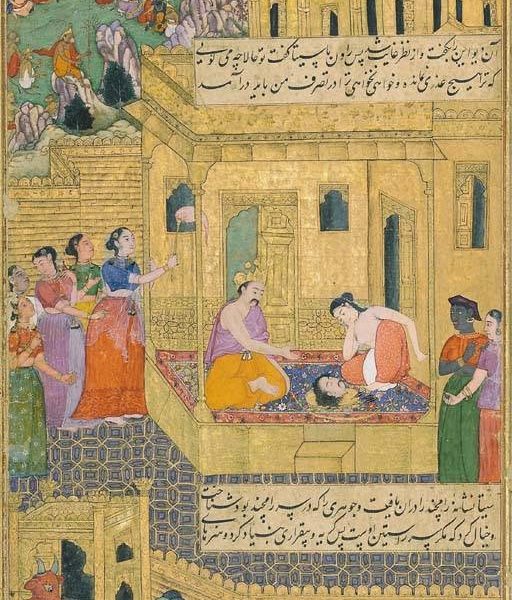
In the late 16th century, Akbar commissioned a Persian version of the ‘Ramayana’. Photo: Facebook/@peepultreeworld.
The present-day poisonous milieu foisted upon us by the regime and its support bases derives its strength from its imaging of the history of India’s medieval centuries, especially of the Mughals, as starkly dark where the mighty state power was driven by the singular objective of erasing the glories of ancient India, i.e. the Hindu society, religion and culture, of which Sanskrit was the supremely elegant manifestation. This image reduces an extremely complex history to a ridiculous simplicity, good enough for popular consumption on TV channels, WhatsApp university and morning shakhas.
However, a few steps up the ladder, at the professionally academic level, the picture loses its simplicity and points to some less-than-dark shades. Even as the simplicity of dark image has never gone unquestioned, a good number of excellent recent works have highlighted the complexity of the interaction between Sanskrit scholarship and medieval Indian society and state.
Advertisement
The 16th-17th centuries, which mark the height of Mughal power, also witnessed the efflorescence of Sanskrit language and Hindu philosophy in society, as well as state patronage of Sanskrit scholarship. In several outstanding recent works, the close interaction between state, society and the dynamics of Sanskrit scholarship has been highlighted; of these I mention only a few.
Sheldon Pollock, ed., Sanskrit Knowledge Systems on the Eve of Colonialism (2005), is a landmark work in more ways than one, almost redefining the world of Sanskrit studies and Jonardon Ganeri’s The Lost Age of Reason: Philosophy in Early Modern Indian India, 1450-1700 CE (2011) recreates the live experiments being made in the Sanskrit philosophy of Nyaya, leading to nav-nyay (“new reason”) and with it the emergence of new centres of Sanskrit studies like Nabadwip (modern Nadia) besides Varanasi.
Historian Audrey Truschke, who has the great asset of mastery of both Sanskrit and Persian, in two books, Culture of Encounters: Sanskrit at the Mughal Court (2016) and The Language of History: Sanskrit Narratives of Muslim Pasts (2021), has brought vividly home to us the significance of Sanskrit as an essential part of Mughal governance especially between about 1550 to 1650. This implied acquiring knowledge of the language, the culture and philosophy associated with it and patronage to Sanskrit scholars; her second book traces the images of the long ‘Muslim’ rule from 1190s to the 1720s by Sanskrit scholars, images that were far from uniform denunciation but understandably varied.
Another brilliant addition to this trajectory is Samuel Wright’s A Time of Novelty: Logic, Emotion and Intellectual Life in Early Modern India, 1500-1700 CE (2021), which recounts how innovations and experiments in intellectual life through different prisms were being created in that era.
Advertisement
All these works of the highest academic quality do not bring to us the image of a static society feeling crushed by a determinedly hostile state but, on the contrary, a very dynamic, creative society where Sanskrit language, culture and associated philosophical schools were emerging and flourishing, never mind what the current regime is determined to foist on us.
If works such as these take us to a high analytical level, at a more empirical plane Pratap Kumar Mishra, back home, Sanskrit teacher in a post-graduate college in Jaunpur (east Uttar Pradesh) has compiled comprehensive details of the extensive patronage extended by Mughal emperors and elites to Sanskrit scholars. Mishra starts with Akbar, naturally, and has thus far published three volumes on Mughal Samrat Akbar aur Sanskrit and one on Khan Khanan Abdur Rahim aur Sanskrit (all in Hindi).
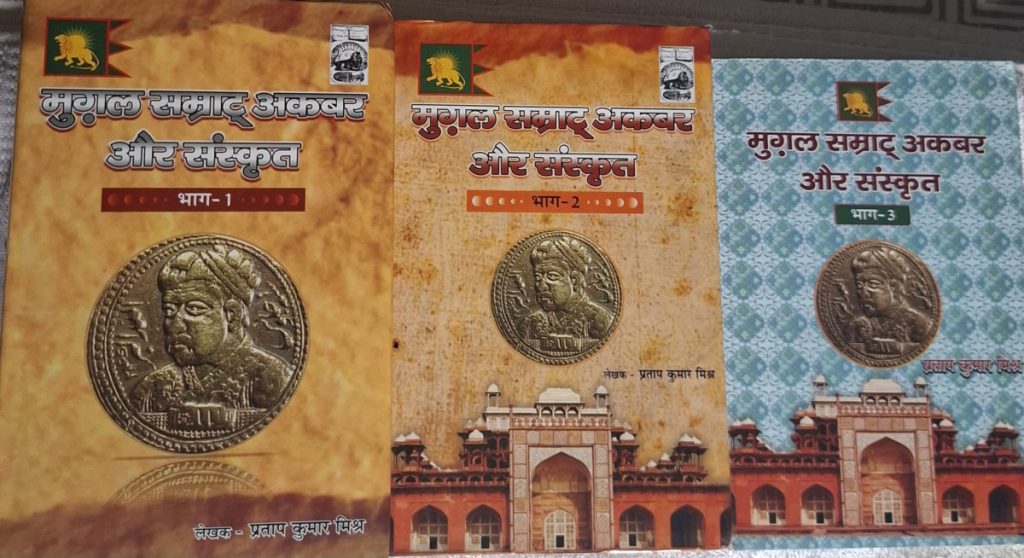
The three volumes by Pratap Kumar Mishra. Photo: Harbans Mukhia.
Of the first set, volume 1, comprising 667 pages, gives us complete details of 36 distinguished Brahmin and 17 Jain Sanskrit scholars patronised by Akbar; there were also seven Muslim scholars of Sanskrit enjoying the emperor’s patronage. Among Brahmin scholars, most were specialists of Hindu philosophy and Vedanta.
The most celebrated was Mahamahopadhyay Pandit Mahesh Thakkur, among a conglomerate of Mithila scholars who initiated a sort of proto-empiricism, where production of proof was the conclusive basis of the veracity of an argument. Akbar was so impressed by his erudition that he separated the administrative unit of sarkar (government) of Tirhut from Hajipur in Bihar and gave it away to Mahesh Thakkur as its master, Mishra informs us, although handing over the revenue collection rights would be closer to the truth. This was later to become the site of the Darbhanga state.
Mishra annexes a long list of Sanskrit texts translated into Persian including scriptures like Balmiki’s Ramayan, Mahabharata, Gita, Srimad Bhagwat Mahapuran, Yoga Vashishta, Atharva Veda, Rajtarangini and others under Akbar’s aegis; several Persian texts were also translated into Sanskrit. These included the Akbar Nama of Abu’l Fazl. Mishra has attached the translation in volume 2.
Advertisement
Mishra has established an All India Muslim-Sanskrit Defence and Eastern Research Institution in Varanasi, just outside the gate of the Banaras Hindu University for this purpose. Clearly, bringing to light the interaction between Sanskrit and Muslim intelligentsia of the past and the present is a life mission of Mishra’s.
Harbans Mukhia taught history at the Jawaharlal Nehru University, Delhi.


Leave a comment