

26/Sep/2026
5 min read


Sumit Sarkar’s essay on Ishwarchandra Vidyasagar from his 1997 book ‘Writing Social History’ epitomises the social historian’s craft at its finest.
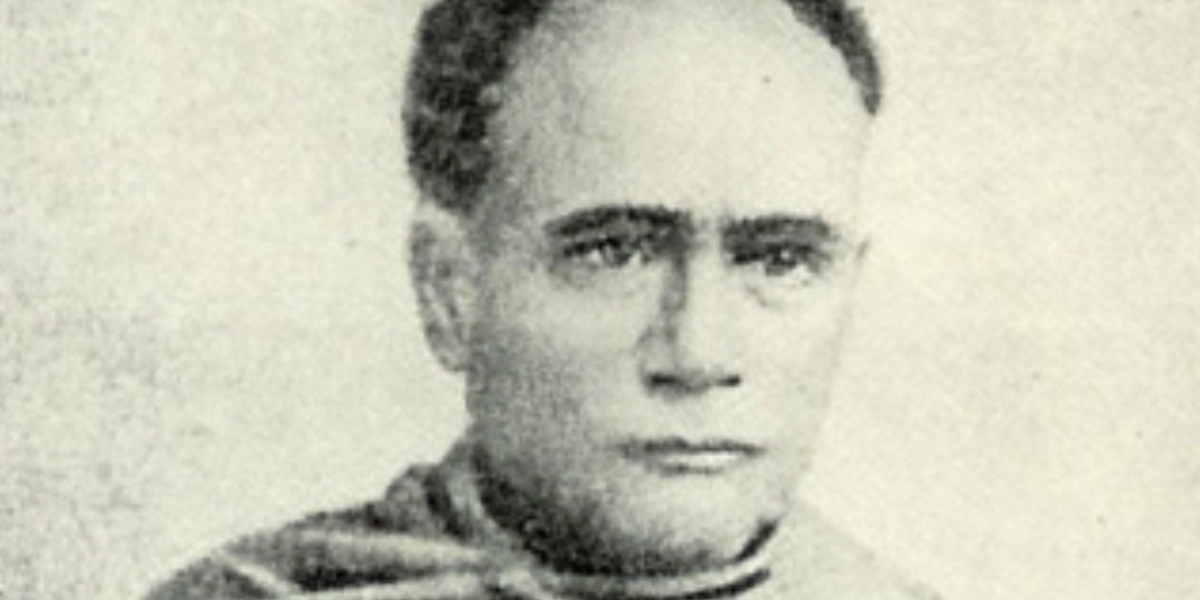
Ishwarchandra Vidyasagar. Photo: Public domain.
Ishwarchandra Vidyasagar was born on this day, September 26, in 1820.
Sumit Sarkar’s essay titled ‘Vidyasagar and Brahmanical Society’ from his 1997 book, Writing Social History, begins on what Sarkar himself acknowledges could sound like a somewhat curious note: with a brief recap of a meeting between Vidyasagar and Ramakrishna that didn’t seem to go down very well with either man. That meeting, arranged at Ramakrishna’s instance at Vidyasagar’s place on August 5, 1882, was, indeed, their only meeting ever. Vidyasagar never returned the visit. The two men, stalwarts in their own right, seemed to agree on precious little except that no one could really hope to know or describe what divinity was.
Advertisement
“But from there their paths diverged radically once more. For Vidyasagar…the unknowability of the supramundane makes it our supreme duty to try to do everything possible to improve this-worldly life. For Ramakrishna, in total contrast, ignorance becomes the premise for faith and devotion, and it is folly and arrogance for men to think of improving the world. The universe inevitably consists (so Ramakrishna believed) of big and small, some with more powers and others with less: it is beautiful because it is structured with hierarchical inequality.”
This comment seemed to provoke a retort from Vidyasagar that implicitly asserted that inequality was not natural but social, and hence ‘open to human remedial action’. ‘The retort clearly rankled with Ramakrishna’, for on a couple of later occasions he is known to have ascribed that response to Vidyasagar’s ‘folly’. He was convinced that the work (‘karma’) Vidyasagar was doing was very good, but believed when that work was to be buttressed by devotion (‘bhakti’) and love for ‘Him’, Vidyasagar’s work-load would ‘lessen’, with God relieving him of much of his burden. When parsed, that really meant that Vidyasagar, in his celebrated contemporary’s view, was overreaching himself.
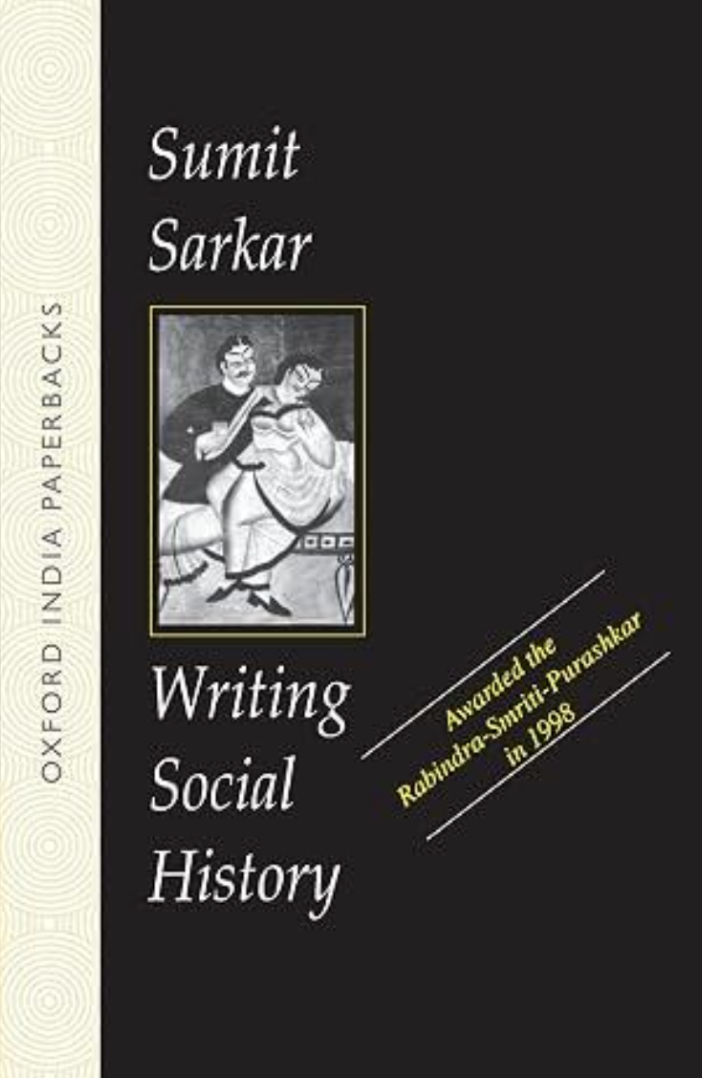
Writing Social History, Sumit Sarkar.
Sarkar soon tells us why this episode was his essay’s point of departure. Despite their very different outlooks on the world, these two contempoaray Bengali stalwarts had emerged from very similar social backgrounds. Their origins lay in poor – indeed, very poor – rural Brahmin families located in the same geography in 19th century Bengal, with their native villages separated by a mere 20 miles.
Again, both their communities drew their moral-intellectual sustenance from the same traditions of centuries-old Brahmanical learning. Besides, for both Vidyasagar and Ramakrishna, it was the move away from the extreme genteel poverty of their village life to urban Kolkata that proved to be the watershed in their lives. But then their individual paths to influence and fame had nothing in common. Those two utterly dissimilar trajectories were both shaped by their lives in the city and in turn shaped large swathes of the culture of the Bengali middle class in significantly different ways.
Advertisement
In two remarkable essays from his book Writing Social History – the one on Ramakrishna titled ‘Kaliyuga, Chakri and Bhakti: Ramakrishna and His Times’ – Sumit Sarkar examines with stunning acuity and sensitivity to detail the dialectics of the processes underlying those profound transformations: in their personal lives as well as in the life of 19th century Bengal. His interventions in debates around how Bengali culture evolved in that period are many and widely acknowledged as stellar. But it’s hardly an exaggeration that, had he written nothing else on that evolution beyond two essays, he would still be recognised as one of the most brilliant minds to have problematised the processes of that evolution and then gone on to decode those processes. Here we take a brief look at the salience of his method in the context, for now, of the essay on Vidyasagar while intending to visit the Ramakrishna essay at a later point.
How Vidyasagar’s many biographies tell us more about their biographers than their subject
A surprisingly large number of Vidyasagar biographies, all written by his Bengali bhadrolok contemporaries, appeared in print soon after his death in 1891. Sarkar counts no fewer than four within the first decade, one of them in English. For comparison: the first biography of Rammohan Roy wasn’t published till 50 years after his death; even for younger contemporary Bankimchandra Chattopadhyay, it took 17 years, and then, it was written by one of Bankim’s nephews.
This laudable chronicler alacrity has its own story to tell. In one voice, the biographies celebrate their subject’s oceanic learning (the honorific ‘Vidyasagar’ really means just that) as well as his legendary compassion and kindness: Dayar Sagar, or an ocean of daya, compassion, was another popular moniker linked to the great man from early on. The chronicles were also full of glowing stories – often unverified, though many plausible enough to carry conviction, but some likely apocryphal – of his steely determination, his phenomenal capacity for hard work, his indomitable courage (both mental and physical), his fabled devotion to his mother, and his penchant for giving back as good as he got, in particular vis-à-vis arrogant Englishmen. These stories were largely unvarying across all the biographies: clearly they had entered contemporary urban lore with great rapidity. But the things most biographies were surprisingly coy about at best – and antipathetic to at worst – were what Vidyasagar himself openly recognised as his life’s mission: radical social reform by way especially of widow remarriage, prevention of child marriage and polygamy. The biographies were also rather thin on Vidyasagar’s relentless drive for spreading public education across Bengal, at any rate on his female literacy initiatives. Indeed, the very large fund of anecdotes about him rarely features episodes linked to his reform projects, though it was well-known even in his time that, often enough, Vidyasagar was obliged to go to extraordinary lengths of trouble and expenses to accomplish a single widow remarriage in the face of implacable societal hostility: indeed, that he was not infrequently driven to near-bankruptcy by his social reform endeavours and his regular philanthropic commitments.
The concomitance of unmixed praise of some facets of their subject’s life and silence about – or, worse, hostility to – some other facets is particularly noteworthy in the context of the profusion of the biographies. Sarkar suggests that what may have been at play here was a desire to sanitise and appropriate an icon’s legacy so as to harness that to social conservatism which was on the rise during Vidyasagar’s last years and in the years immediately following them. In this, Sarkar sees a parallel to Hindutva’s efforts almost a hundred years later to try and appropriate Dr B.R. Ambedkar. Thus, Vidyasagar’s radical social reforms were presented as arising from an ‘excess of compassion’ gone wrong. Some biographer, while decrying those reforms, yet urged his compatriots to be imbued with the kind of passionate commitment that Vidyasagar brought to his work. Only their task should be, he suggested, to defend the shastras (scriptures), not undermine them.
Advertisement
Relatively little-known part of Vidyasagar’s social messaging that earned him few friends
Vidyasagar, to the contemporary bhadrolok’s chagrin, argued often and energetically against the traditional joint family structure, deeming it undesirable from the standpoint of healthy intrafamilial relationships. Convinced that income disparities, and temperamental and other asymmetries, hardly make for an ambience of mutual respect and trust, he advocated instead for the small-family home which, he suggested, would make it likelier for members of extended families to help and support one another across their units with grace.
From the outside, Vidyasagar seemed to be perhaps the unlikeliest interrogator of the joint family. All his adult life he had supported, scrupulously and unfalingly, not only every member of his and his brothers’ families, but countless others from the village community he came from, including feeding, housing and schooling their children in Kolkata. Indeed, when in November, 1869, he formally broke with every member of his family including his mother, wife, brothers and their families and even his native village, he stipulated in meticulous detail monthly allowances for every member of the extended family (as well as for the philanthropic institutions he had started in his village) to be paid out of his personal earnings. The causes precipitating this break are not clear, but it was a permanent rupture. He never visited his village again.
So Vidyasagar’s advocacy against the joint family should have prompted careful consideration. Instead, it earned him no small measure of social opprobrium, and Sarkar shows us why. Mid-to-late 19th century was proving to be a period of increasing precarity for widening sections of the poorer, but educated, middle class. With striking perspicuity, Sarkar traces the reasons why their fortunes had risen and then plunged.
Advertisement
So fresh networks of intra-community support for the bhadrolok needed to be explored rather than dismantling the few still in existence, however perilously. Sarkar shows how carping biographers had been nervous beneficiaries of the joint family system themselves.
Were his social reform initiatives propelled by scriptural exegesis?
This has been an on-again-off-again debate for a long time.
Many commentators have argued in favour, with some going to the extent of tying their answer to what they see as the essentially traditionalist, orthodox kernel of Vidyasagar’s social thought. Sarkar puts it beyond all doubt, however, that Vidyasagar’s reform projects were driven in their entirety by a combination of his overarching rationality, his acute sense of right and wrong, and his truly infinite capacity for compassion. Of course he strived hard to bolster his case by presenting favourable scriptural interpretations in its support, but that was only part of his weapons arsenal, not his motivation.
The arsenal was put together with an eye on his conservative anatagonists for whom only scriptural interprtations could clinch the issue. Sarkar notes that indeed Vidyasagar’s first essay on social reform – Balyabibaher Dosh or ‘The Evils of Child-Marriage’, 1850 – was marked by a total absence of textual exegesis.
“Partly for this reason”, he tells us, “it was also his most radical statement on gender relations…able, within a few, brilliantly written pages to unfold an integrated, comprehensive critique of child marriage, arranged marriages, marital oppression, taboos against educating women, and the horrors and evils of austere widowhood.”
The essay is a trenchant denunciation of both text and custom, and demonstrates how the two, in combination, had produced, and continued to sustain, all that Vidyasagar found problematic about existing marital practices. Throughout the essay, Vidyasagar judged the existing institutions and practices around marriage “against an ideal norm of companionate conjugality based on adult mutual love… (which) can flow only from a unity of minds, (which, in turn, is) impossible if girls are married off at eight, nine, or ten…”.
It is worth making an effort here to try and absorb the really revolutionary message implied in Vidyasagar’s lines, considering the social, intellectual, and moral context of his work on gender relations.
Vidyasagar’s educational programme
Beginning with fairly radical revisions to the syllabus of the Sanskrit College that pushed the curriculum in a recognisably modern, rationalistic direction, Vidyasagar went on to propose an expansive vision of public education for Bengal. At the project’s core was promoting vernacular education with the object of “the creation of an enlightened Bengali literature” that would facilitate “the study of useful and instructive subjects” like mathematics, astronomy and natural science through competent Bengali translations of contemporary English texts. While he envisaged Sanskrit College students proficiency in Bengali and a good grounding in English (besides mastery of Sanskrit), he proposed a sustained drive for public education through networks of vernacular schools (model schools as well as normal schols, both teaching English in the higher classes) supported by standard vernacular text-books to be taught by ‘perfect masters of their own language’ who were ‘free from the prejudices of their country’. Those teachers were to be initially recruited from among Sanskrit College graduates. The college would also house a training facility for school principals. Schools were to be funded in part by the government, with the rural gentry picking up the other part. As Assistant Inspector of Schools for four districts, Vidyasagar soon established 20 model schools and a significant number of normal schools across those districts. Against formidable local opposition, he opened a more limited, but still substantial, number of girls’ schools also: at least 40 such between November 1857 and June 1858 alone.
Vidyasagar himself provided most of the primers and text-books as well, besides an easy-to-teach, more modern Sanskrit grammar. He lobbied extensively with both British officials and local gentry, both for school funding and for getting around local resistance. He was clearly focussed on bridging the growing gap between the traditional literati and English-educated intelligentsia, not through eclectic compromises but remodelling and moving past both those poles. This was a highly demanding, even bruising, process in which Vidyasagar needed to navigate around entrenched interest groups and, inevitably, he was obliged often to concede ground, even to abandon projects. After 1857, the colonial bureaucracy, somewhat supportive of Vidyasagar’s efforts until then, also grew noticably less friendly and open to his ideas.
Meanwhile, a steadily stricter administration of the Permanent Settlement’s Sunset Law, even as land productivity and land revenue declined, continued to squeeze local zamindars’ ability and willingness to pitch in with funding. Finally, a brash young Englishman civil servant, recently placed at the head of public education, began throwing his weight around, and a heartbroken Vidyasagar summarily resigned his position, leaving many fledgling projects unfinished. He was 37.
It’s important to recognise the limits of his pedagogy, however. The textbooks and primers he authored all foregrounded two themes: self-improvement through hard work and the need for rigorous self-control and discipline. Grim and humourless in tone and intensely moralising, his primers were bleak in their messaging even as they provided children with the building blocks of Bengali prose and punctuation. Sarkar has also pointed to an unmistakably status-quo-ist vision of property relations informing all these works.
But rather than putting these features down to ‘hard-baked, bourgeois individualism’ (as some commentators have done), he situates Vidyasagar’s pedagogy in the specific social context that privileged those particular moral imperatives over more liberal, progressive ones, suggesting that the steady erosion of career opportunities at the material time, particularly for the rural, poorer gentry, made that utilitarian work ethic more a necessity than an ideological preference.
The man in his time
Amidst widespread efforts to sanitise the essentially revolutionary kernel of Vidyasagar’s social thought, this is what Rabindranath Tagore said about him in 1895:
“Vidyasagar had been alone in Bengal. It is as if he had had no kith or kin in this land…He was not happy here…He had a deep contempt for this weak, petty, heartless, lazy, arrogant, argumentative people, for in every way he was their opposite…”
Sumit Sarkar’s appraisal, while in effect echoing Rabindranath, adds perspectives on the society that obliged Vidyasagar ro make compromises and how those compromises circumscribed some of his noblest efforts.
Anjan Basu can be reached at basuanjan52@gmail.com.


Leave a Reply