

A journalist who writes in
hindustantimes.com · thesouthfirst.com · mongabay.com · downtoearth.org.in · outlookindia.com · thehindu.com · openthemagazine.com · nationalheraldindia.com · journalistcafe.com · journalistcafe.com
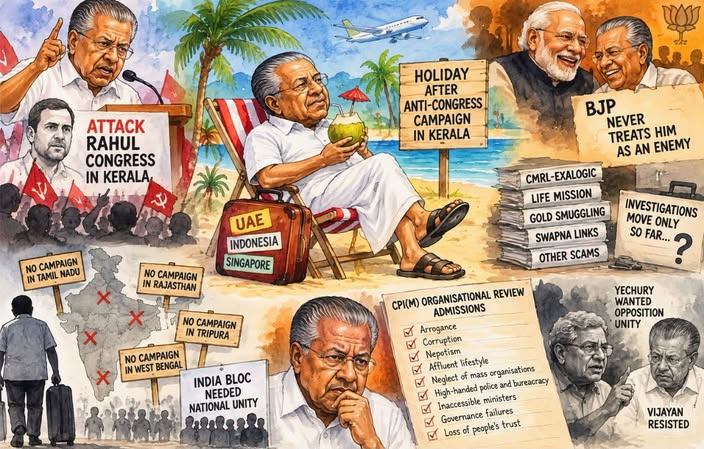
Abhijit Dipke, before presenting Pinarayi Vijayan as a champion of the national fight against Narendra Modi, answer a basic question: what, precisely, has he done to strengthen the struggle against the BJP outside Kerala?
Vijayan spent ten years as Chief Minister. He is now the Leader of the Opposition in Kerala. Yet his admirers seem more interested in manufacturing a national stature for him than examining his political record. Where is his contribution to sustained national struggles against the Modi government? Where is his initiative to build opposition unity? Where is his campaign to strengthen the INDIA bloc beyond the boundaries of Kerala?
Consider the 2024 Lok Sabha election. Vijayan made Rahul Gandhi and the Congress his principal political targets in Kerala. He questioned Rahul’s decision to contest from Wayanad and repeatedly attacked the Congress leadership. He was entitled to fight the UDF. Nobody disputes that. But after Kerala voted on April 26, he left for a foreign holiday with his family, visiting the UAE, Indonesia and Singapore, while the national election was still under way.
Why did he not campaign for CPI(M) candidates in Tamil Nadu, Rajasthan, Tripura or West Bengal? Why was he so energetic in attacking Rahul Gandhi in Kerala but absent from the campaign trail for his own party’s candidates elsewhere? The CPI(M) was contesting in other states, and the INDIA bloc was engaged in a national battle against the BJP. Did that responsibility not matter to the Chief Minister of Kerala, a senior leader of the Left and a member of the national opposition alliance?
This is not a trivial question about one leader’s travel schedule. It exposes the political priorities of a leader who appeared to regard defeating the Congress in Kerala as more urgent than helping the national opposition challenge Modi.
Remember Sitaram Yechury. The late CPI(M) general secretary understood the importance of bringing secular and democratic forces together. He knew that the Congress could be the Left’s principal rival in Kerala and still be an important partner in the national struggle against the BJP. Yet Vijayan’s uncompromising hostility towards the Congress repeatedly complicated that effort. Even during the 2024 campaign, Yechury expressed concern about the public confrontation between Vijayan and Rahul Gandhi.
The contradiction was fundamental. The CPI(M) was part of the INDIA bloc nationally, but its Kerala leadership relentlessly attacked the Congress, the principal national opposition party. Yechury and other advocates of broader opposition unity were left to reconcile the party’s national responsibilities with the Kerala leadership’s determination to defeat the Congress.
The BJP’s political project of a Congress-mukt Bharat is well known. It has every interest in exploiting divisions among opposition parties. When Vijayan repeatedly weakens the credibility of Rahul Gandhi and the Congress, the political consequences cannot be separated from that larger context. I am not claiming that a secret agreement between Vijayan and the BJP has been established. I am asking why his political strategy has so often served to deepen the divisions that the BJP has an obvious interest in exploiting.
The record of his own government makes the attempt to portray him as an uncompromising national opponent of the BJP even more difficult to sustain.
We no longer need to depend only on the government’s critics to examine the failures of the ten-year LDF administration. The CPI(M)’s own organisational review of its 2026 Assembly election defeat has acknowledged serious failures in governance and party functioning. It identified arrogance, corruption, nepotism and affluent lifestyles among sections of party leaders and cadres, as well as the failure to take timely corrective action. It admitted that the party had neglected mass organisations and allowed sections of the public to drift away during the ten years of LDF rule. It also criticised the high-handedness of the police and bureaucracy, the inaccessibility of ministers and the excessive reliance on government officials instead of sustained engagement with people’s problems.
These are not allegations invented by the Congress or the BJP. They are admissions arising from the CPI(M)’s own examination of its defeat. The party also acknowledged that the campaign had become excessively personalised around Vijayan, giving the UDF an opportunity to focus on him while the Left lost the initiative to advance its wider political arguments.
The PM-SHRI controversy and the decision to have a minister read out a message from Uttar Pradesh Chief Minister Yogi Adityanath at the Global Ayyappa Sangamam further exposed contradictions between the government’s actions and the CPI(M)’s secular political positioning. The party’s own review recognised the damage such decisions caused to its secular image.
What, then, are we being asked to celebrate? A decade of governance that the party itself has now subjected to serious criticism? A political strategy that repeatedly undermined national opposition unity? Or a leader who directed his principal electoral energies against Rahul Gandhi while the national battle against the BJP continued elsewhere?
The questions surrounding central investigations into allegations involving Vijayan’s government and his family also deserve public scrutiny. The allegations concerning Cochin Minerals and Rutile Limited and Exalogic Solutions, among others, have generated serious political controversy. Investigating agencies must pursue their responsibilities, and courts must determine the facts. That is not a licence for political commentators to declare guilt. But neither should anyone demand that the public stop asking why investigations into politically consequential allegations have not reached a conclusive resolution. Where investigations appear to advance only so far and then remain unresolved, accountability requires explanation. Whether the BJP possesses political leverage over Vijayan is a question that may be raised in political debate, but it must not be presented as an established fact without evidence.
Now consider the electoral process itself. Kerala’s experience with the Special Intensive Revision of electoral rolls demonstrated the importance of collective vigilance by non-BJP political parties, opposition workers and citizens. The exercise was completed in Kerala, so it would be inaccurate to claim that SIR was never implemented. The significant point is that electoral-roll revision cannot be treated as a purely administrative exercise beyond political and public scrutiny. The protection of eligible voters depends on vigilance, access to claims and objections, and the willingness of political parties to challenge possible exclusions. Kerala’s experience should be understood in that context, not appropriated as the achievement of any single leader.
This brings us back to the central issue. Kerala’s political landscape has long been dominated by the contest between two secular formations, the LDF and the UDF, while the BJP has remained outside the principal contest for power. That democratic rivalry is legitimate. I have no objection to Vijayan fighting the Congress in Kerala, or the Congress fighting the Left. But the national opposition cannot afford to confuse the defeat of the Congress in a state election with the larger objective of challenging the BJP nationally.
The same question must be asked of Arvind Kejriwal and other opposition leaders whose confrontations with the Congress have complicated broader cooperation. Their political circumstances differ, but the consequences of fragmentation matter. The BJP does not need every opposition leader to join its ranks. A divided opposition can advance the BJP’s political interests without any formal alliance.
Abhijit, political literacy means examining what a leader actually does, not simply repeating what his admirers claim about him. It means distinguishing between a party’s ideological legacy and the record of its present leadership. It means asking where a leader campaigned, which struggles he supported, how he treated opposition unity and what consequences followed from his choices.
Vijayan was entitled to fight the UDF in Kerala. He was not entitled to immunity from criticism when his political strategy repeatedly undermined the national opposition. His party’s own organisational assessments have now exposed serious failures in governance and political functioning. His record during the 2024 national campaign raises equally serious questions about his commitment to opposition unity.
The question is not whether Pinarayi Vijayan has occasionally criticised Narendra Modi. The question is what he has actually contributed to the national struggle against the BJP, and why his political conduct so often weakened the very opposition that was trying to challenge it.
Before crediting him with the achievements of a national democratic resistance, please examine the record. Political history cannot be rewritten through selective memory, partisan loyalty or the convenient invention of national heroes.


Leave a Reply