



06/Oct/2026
5 min read


Gandhi taught us that the means matter. Nehru taught us that freedom requires freedom of action. King taught us that justice is indivisible.
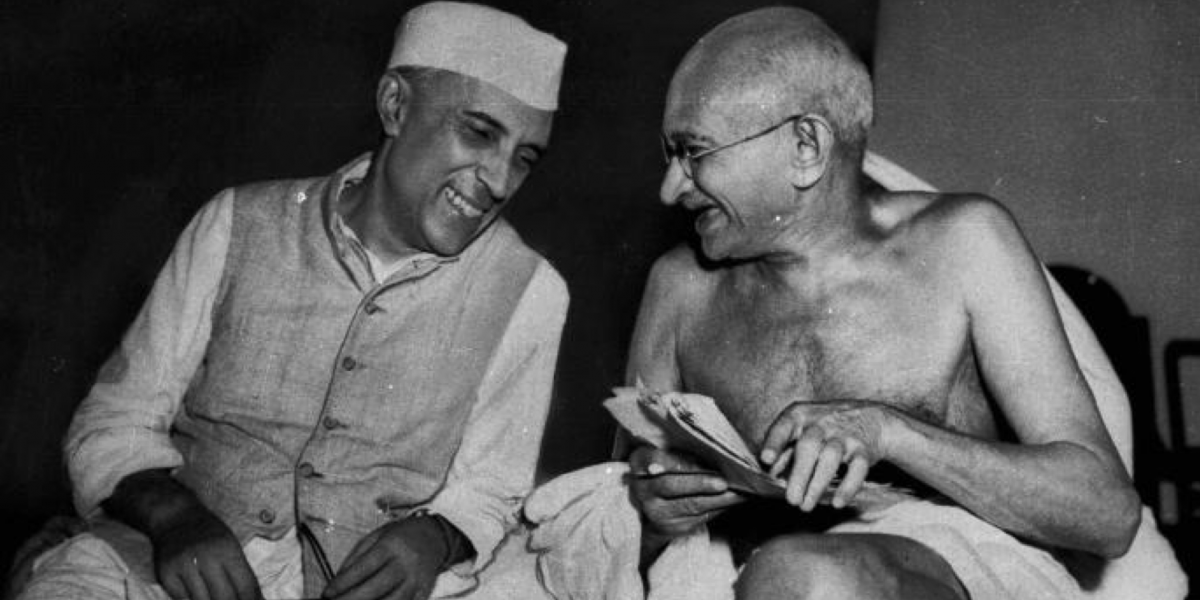
Jawaharlal Nehru and M.K. Gandhi. Credit: UN Photo.
The following text is economist Santosh Mehrotra’s speech at Voices of the Republic conference, organised at Hunter College, Roosevelt House, October 1-2, 2026.
§PlayNextMute
Current Time 0:04
/
Duration 2:04FullscreenBackward Skip 10sPlay VideoForward Skip 10s
Advertisement
Let me begin with the context of contemporary India, before turning to Nehru. India is seen since 2019, as an “electoral autocracy” by the V-Dem Institute (Varieties of Democracy), based at the University of Gothenburg, Sweden. This is not a rhetorical statement.
It is part of its “Regimes of the World” classification, which distinguishes liberal democracy from electoral democracy, electoral democracy from electoral autocracy and electoral autocracy from closed autocracy. It came about after being in a “grey-zone” electoral autocracy category from 2017, and eight years later, India remains an electoral autocracy in 2025 (till 2008 in the best category of liberal democracy).
With the Special Intensive Revision (SIR) subversion by the Election Commission of India (ECI) by eliminating arbitrarily 130 million voters from its rolls (who voted in 2024 and elected the current government), India is likely to classify in the worst category, a ‘closed autocracy’, if SIR is not rolled back – after the ECI has been exposed within this last few weeks.
Jawaharlal Nehru’s vision of giving adult franchise in 1947 – long before Martin Luther King and his black brethren got the vote in the USA through their movement in the 1960s – made India into a ‘precocious democracy’. That vision is already overturned by the current government.
Advertisement
Nehru was also the originator of the notion of non-alignment in foreign policy at the start of the Cold War. Nehru explained India’s foreign policy in a sentence that I think has extraordinary relevance today. In 1963, he said: “Essentially, non-alignment is freedom of action which is a part of independence.”
That, I believe, is the starting point for thinking about Gandhi, Nehru and Martin Luther King Jr. in today’s troubled world. All three were concerned, in very different ways, with one fundamental question:
What does it mean to be free?
Gandhi taught us that the means matter. Nehru taught us that political freedom requires the capacity to make independent choices. And King taught us that freedom without justice is incomplete.
These are not identical philosophies. But together they offer a remarkably powerful framework for our own time – provided we marry it with Kishore Mahbubani’s insight that the world is not merely multipolar (a fact the West has difficulty in recognising); it is also Multi-civilisational (not dominated by the West as it was for the last 250 years till about 2000); and hence is not likely to accept lying down unilateralism by the West (and its allies, e.g. Israel), but insist on multilateral decision-making (the three Ms).
Nehru and strategic autonomy – a tenet of our foreign policy
When India became independent in 1947, the world was bipolar. The United States and the Soviet Union were the two great powers. India chose non-alignment. India could agree with Washington on one issue and Moscow on another. It could disagree with both.
Advertisement
Non-alignment was not equidistance. It was freedom of judgment. That distinction matters enormously today. The world in which Nehru operated no longer exists.
In the bipolar world (1945 to 1990), the US built up its empire through military bases. One particularly useful historical series gives the scale of the early postwar expansion: the US had approximately 1,139 overseas base sites in 1947, fell to 582 in 1949, and then rose again to 815 by 1953, largely because of the Korean War and Cold War requirements.
The American global base system was created principally between 1940 and 1953: first through the extraordinary wartime mobilisation of 1940–45, and then through the conversion of a portion of that wartime infrastructure into a permanent Cold War system from 1945–53. The extraordinary geographical expansion happened remarkably quickly — within about 13 years.
And there is an interesting historical irony: in 1938 the US had only 14 overseas military outposts; by 1945 it controlled more than 30,000 military installations worldwide. Most subsequently disappeared, but the strategic core survived and was institutionalised during the Cold War.
Advertisement
This history makes a very powerful comparison with Nehru’s non-alignment: the US constructed a global system of military alliances and bases after 1945, while newly independent India deliberately rejected incorporation into either Cold War military bloc.
After 1991, the world became temporarily unipolar, with the United States overwhelmingly dominant. This period barely lasted a couple of decades – but clearly through its expansionist foreign policy plus illegal wars of aggression, including in Ukraine and Iran, it has used these bases with effect.
But after the global financial crisis of 2008, the international system began changing again. What changed? It became multipolar: China emerged as an economic and technological power. Russia recovered from the economic collapse of the 1990s. India became a much larger economy. BRICS emerged.
And now BRICS has evolved from five countries into a much larger grouping of major emerging economies. We are therefore moving towards a more multipolar world. So the question for India today is: What does strategic autonomy, the bedrock of India’s foreign policy stance, mean in a multipolar world?
My answer is simple: India should be able to work with the United States, Russia, China, and the countries of the Global South. That is not anti-American. It is not pro-Russian. It is not pro-Chinese. It is simply the logic of an independent foreign policy.
India and the United States
India’s relationship with the United States is enormously important. There are powerful reasons for it: technology, trade, defence, education, investment and the Indo-Pacific. And the Indian diaspora has created extraordinary human connections between our two countries. But strategic partnership must not become strategic dependence.
The USA has always been an imperial power, and treated India in last two years with contempt, having cast aside the four-member Quad. The recent economic relationship provides a useful test. First, the February 2026 interim trade framework put an 18% US tariff on Indian goods, while India agreed to 0% tariffs on a wide range of US products.
Second, India expressed an intention to purchase more than $500 billion of US products over five years – with no reciprocal commitment. Third, contrary to India’s farmers interest, it agreed to include farm produce (cotton, soybean meal) as imports – against the interest of our farmers.
Fourth, Washington linked tariff relief to India’s decision to stop purchasing Russian oil. More recently, Graham legislation signed by US President Donald Trump gives the US administration the authority to impose tariffs of up to 100% on countries purchasing substantial quantities of Russian energy, potentially including India. This impinges on India’s sovereignty & should be unacceptable. Whatever one’s view of these policies, there is a larger lesson:
Economic dependence can become US’s geopolitical leverage. And that is precisely why strategic autonomy today must be more than a diplomatic doctrine. It must be an economic doctrine.
Finally in early 2026, USA’s intentions towards India became clear. US Deputy Secretary of State Christopher Landau, speaking at the Raisina Dialogue, said that Washington did not want to repeat with India what it regarded as its mistake with China.
He said, in effect, that the United States would not help develop another country only to discover that it subsequently became a major commercial competitor – which shows the US is not interested in promoting India as a countervailing force to China (as a Quad member, so Quad is likely dead).
America has the right to pursue America’s interests. India must therefore have the capability to pursue India’s interests. That is strategic autonomy.
Autonomy begins at home
Nehru understood that political independence would remain fragile without economic capability. As a post-colonial country, plundered by the UK, from contributing 25% to global GDP in 1700, it came down to 4% in 1947.
India had very little industrial capacity, very little technological capability, very low literacy and extremely weak infrastructure. His answer was five year planning to build national capabilities: industry, science, technology, technical education, infrastructure and institutions. However, 11 years ago, that planning process and commission was destroyed by the Narendra Modi government; India became the only Asian economy without a planning ministry.
Also read: Nehru at Bandung: Notes From a Conference Slip Pad
Today, strategic autonomy is threatened by continued excessive imports from China. However, India now commits itself to import $500 billion from USA as well. So that requires us to ask: Where do our pharmaceutical ingredients, or our solar panels or semiconductor technologies come from? In the age of AI, who owns the intellectual property? The data? The compute on which artificial intelligence depends? Its mostly US Mag 7. This cannot continue.
These are no longer simply commercial questions. They are questions of national capability.India therefore needs a serious industrial policy. That is the meaning of strategic autonomy in foreign policy.
Why BRICS matters?
India does not regard BRICS as an anti-US organisation.
BRICS matters because between the five original BRICS, their combined GDP in PPP in 2025 ($88 trillion) is much larger than G7 ($62 trillion), and more than double that of EU27 ($30 trillion) – which was not the case 20 years ago. And this growing divergence will sharpen over the next 30 years, as the BRICS (especially India) grow much faster than either the G7 or EU27. These emerging economies want a greater voice in the institutions that govern global finance, trade, technology and development.
India’s 2026 BRICS chairmanship and the New Delhi Declaration have placed considerable emphasis on development, productive capacity, technology, resilient supply chains and financial cooperation. The New Development Bank provides another source of development finance.
Greater cooperation in payments can reduce some vulnerabilities associated with dependence on a single financial system. It is not de-dollarisation – dollar is dying on its own because the US weakened itself with a $40 trillion debt, with $1 trillion being as interest. The dollar share in global forex reserves has fallen below 40% – a wake up call to the US’s petrodollar hegemony.
Notably, cooperation among emerging economies can give them greater bargaining power. None of this requires India to abandon the United States. Strategic autonomy means having more than one option.
Gandhi and the idea of India
There is another dimension of strategic autonomy: internal cohesion. This is where Gandhi becomes essential. India is one of the world’s four oldest, and great civilisational mosaics – of languages, religions, cultures and histories.
Gandhi did not believe that Indians had to become identical in order to become one nation. And the constitution embodies the same principle: unity through equal citizenship, not uniformity. That is not simply a moral proposition. It is an economic one.
A country of 1.4 billion people cannot afford persistent social conflict. There is no country in the world as diverse as India – none. That means only we can govern ourselves as a democracy and a federation. But development is equally important to us.
Development requires trust, investment requires stability, and innovation requires openness and a scientific temper – all attacked daily by the Rashtriya Sawayamsevak Sangh (RSS). Inclusive development also requires that the coalition of the corporate agenda and corporate support for the Hindutva agenda needs to be dismantled otherwise neither rising inequality nor rising ‘othering’ in a fascist agenda can be rolled back.
Social cohesion is therefore not an ornament to development. It is one of its foundations. Mohan Bhagwat, RSS head, went to New York City and gave a message of One World unity; how about unity in India between Muslims and Hindus – that they oppose.
Gandhi gave us a wonderfully demanding definition of patriotism: “By patriotism I mean the welfare of the whole people.” Not just of Hindus!
Martin Luther King and the idea of justice
King took a similar question into the American context. Civil rights could not simply mean removing legal discrimination. It had to include economic opportunity. King said: “Injustice anywhere is a threat to justice everywhere.”
Patriotism need not become hostility – to another nation or Muslim-Christian Indian citizens.
India’s real strategic imperative? It is development and economic opportunity.
And let me finish where I began as an economist. Why does all this matter? Because India’s strategic autonomy ultimately has to serve India’s development. India has a limited window in which to convert its demographic structure into a genuine demographic dividend. Only 15 years are left.
A young population is not automatically a dividend. But above all, they need productive employment; 12 million per annum, not half that number, this so called fastest growing economy, sixth largest, is generating (as I argue in my latest book India Out of Work); not a falling share of manufacturing – unlike all the hype of ‘Make in India’; not a rising share of workers in agriculture – 80 million were added to agriculture in the last four years – the opposite of what India needs. This is structural retrogression, not positive structural change brought about by government economic policy in the last ten years.
Worse, the concentration of ownership of industry and capital in India has grown so acute in the last decade, that employment is not a priority for the state or for big business; only GDP growth is – that essentially benefits mainly corporates at the expense of MSMEs, that create most jobs. That cannot be the economic basis of strategic autonomy.
Gandhi, Nehru and King today
So let me return to the three legacies with which I began.
Gandhi taught us that the means matter. Nehru taught us that freedom requires freedom of action. King taught us that justice is indivisible.
For India, these three ideas lead to a demanding proposition. We need an India economically capable enough to be strategically autonomous and technologically capable enough to make its own choices. As Nehru taught us, India should be socially cohesive enough to remain united in its extraordinary diversity, as Gandhi taught us India should be sufficiently committed to justice that development is measured not merely by GDP, but by the lives people are able to lead – as we learnt from King.
Strategic autonomy therefore means having the freedom to engage with the world on our own terms. But the freedom to choose our own path, that I believe, is the common challenge that Gandhi, Nehru and Martin Luther King leave us. And in a troubled world, it is a legacy worth reviving.
Santosh Mehrotra is a former professor of Economics in Jawaharlal Nehru University.


Leave a Reply