

Daniel Kent-Carrasco Instituto de Investigaciones Históricas, UNAM, Ciudad de México, México 1. Introduction In the 1950s and 1960s, the meaning of socialism became a crucial matter for thinkers, politicians and ideologues across the Third World. The goal of socialism was central to a broad transnational movement that sought to alter the balance of geopolitical and…
Translate:मराठीहिन्दी
October 20, 201939 min readVol. 73, No. 38

Daniel Kent-Carrasco
Instituto de Investigaciones Históricas, UNAM, Ciudad de México, México
1. Introduction
In the 1950s and 1960s, the meaning of socialism became a crucial matter for thinkers, politicians and ideologues across the Third World. The goal of socialism was central to a broad transnational movement that sought to alter the balance of geopolitical and symbolical power in a rapidly decolonizing world. At the same time, socialism was also widely wielded as a project of alternative social and personal transformation, defined by the ideals of autonomy, freedom, collectivism and solidarity. For many who during these decades adhered to the cause of revolution, the project of socialism necessarily had to go beyond the confines of formal politics to effect a transformation in what Julius Nyerere called the ‘attitudes of the mind.’(1) For an entire generation of thinkers, activists and politicians across the globe socialism defined, as Che Guevara would have it, the quest for a new man.(2)
In India, during these decades socialism ceased to be the sole patrimony of the more radical factions of the nationalist movement and was adopted as part of the official project and rhetoric of the national state, mainly as a result of Jawaharlal Nehru’s statist socialist leanings, and his enormous influence on the national and international scenes. Along with the principles of secularism, non-alignment and democracy, socialism became central to the roadmap of socioeconomic development charted by the new national state. In Nehru’s view, socialism essentially meant state control over the means of production, and the adherence to a form of economic planning that favoured rapid industrialization and aimed at an increase in production that would vanquish poverty from India. In anticipation of what would become a widespread project of Third World nationalism across different locations in later years, Nehru promoted a cosmopolitan agenda of economic independence that saw growth and development as an entitlement of the newly decolonized countries of Asia and Africa. In his words, socialism effectively meant ‘every individual in the State should have equal opportunity for progress.’(3)
In this paper, it is argued that despite its adoption as the official credo of the Nehruvian state and in spite of the fragmentation of older leftist forces during the first two decades following the transfer of power, socialism remained a central category for doctrines and practices of protest and contestation in India. This paper will chart the main contours of a clash over the meanings of socialism that during the 1950s and early 1960s confronted Jayaprakash Narayan and Rammanohar Lohia, two important leaders of the old Congress Socialist Party (CSP; 1934) and stalwarts of the left in India. Jayaprakash Narayan, or JP as he was popularly known, was the main architect of the CSP and remained the leading ideologue and most visible leader of Congress socialists until the early 1950s, when he voluntarily retreated from institutional politics – which he began to refer to as Raj Niti or power politics – and drifted towards constructive activism and the promotion of Lok Niti, a politics of the people. Following JP’s distancing from party politics, Lohia arose as the most important figure in the ranks of the Socialist Party. In the years following the transfer of power, both identified socialism with the need to oppose the reactionary tendencies of the Congress and the new state and promote the radical transformation of society. However, as a result of their differing conceptions of revolution, the shape and possible outcomes of this transformation were imagined in entirely different ways by each of them.
Despite arising as responses to national – and at times very local – concerns and conjunctures, the thought and politics of JP and Lohia were attuned with broader radical movements taking shape in different locations in opposition to the establishment of the Third Worldist model of developmental nationalism. Both wielded socialism as an integral part of their fierce critique of the Nehruvian state’s acceptance of foreign models of socioeconomic organization. However, as will become clear, they had little in common beyond this shared opposition. JP, on the one hand, increasingly came to see socialism as a communitarian project of moral and anti-political protest in the face of an alienating state power. On the other, Lohia clung to a project of socialism defined by institutional opposition against the ‘pedagogical style of politics’ fostered by postcolonial elites during the 1950s.(4) Despite the fact that this battle over meanings would not materialize in immediate political gains for either one, the impact of their ideas opened up a space for the emergence of original conceptions of socialism wholly unrelated to anything known elsewhere by that name and, as a result, proved crucial for the inauguration of a set of political trajectories – both on the left and on the right – central to the contemporary political horizon of India.
Moreover, and beyond its relevance to the history of political thought in contemporary South Asia, this battle over the meanings of socialism exemplifies the ways in which political programmes in different parts of the world were being shaped and cemented in the decades of decolonization and the intensification of the Cold War, both in response to global and local challenges. The politics of protest of JP and Lohia testify to the fact that the projects of Third Worldism and the consolidation of postcolonial national regimes were from the start deeply contested by important sections of anticolonial elites in locations such as India. At the same time, they testify to the fact that, during the 1950s and 1960s, socialism was also used to promote intellectual projects based on the need to go beyond the ideological and political constraints of the Cold War, which shaped the positions of most postcolonial leaders, including those who considered themselves non-aligned.
The paper will start by outlining the projects of socialism defended by JP and Lohia during the 1950s and 1960s and will stress that in order to come to grips with their original approaches to socialism, we must take into account their particular position as non-elite leftists among nationalist ranks, the impact of their international sojourns as young students and their ambiguous relationship with Gandhi’s ideas. I will then contrast their postures of opposition to the Nehruvian model of industrial development by focusing on JP’s equation of socialism with the Gandhian model of Sarvodaya, and Lohia’s views on decentralization and the project of the small machine. A third section deals with the fundamental opposition between JP and Lohia’s politics, which stemmed from the incompatibility of reconciling JP’s emphasis on the notion of freedom and Lohia’s insistence on the importance of equality. I wrap up the article commenting on the importance of these contending projects of socialism for local genealogies of politics in India, as well as for globally spread projects of revolutionary and radical politics.
2. The politics of JP: from Socialism to Sarvodaya.
Born in 1902 in the village of Sitabdiara, in West Bihar, JP was, both symbolically and chronologically, a product of the Swadeshi years. Throughout his life, he consistently referred to the Non-Cooperation Movement as ‘the most glorious page in the living History of (India’s) National Revolution’(5) and the moment of birth of what he considered as the only valid and truly Indian tradition of politics. Born into a family of relatively poor country kayasthas, JP had to secure a government scholarship in order to pursue his studies at Patna College. When he threw his books into the bonfire of non-cooperation, he was not following a liberal political commitment or taking a radical anarchist stance. Being a non-elite revolutionary, the prospect of Swaraj for JP was tinged by the anxiety generated by the possibility of failure. In this sense, the prospect of revolution held a special urgency for him, having as he had rejected the chance of a government education, and being unable to afford an English upbringing, like the one pursued by many of the most important leaders of the Congress.
Following Gandhi’s decision to bring the Non-Cooperation Movement to a halt following the events at Chauri Chaura in February 1922, JP applied for a visa to the United States and sailed east with the purpose of carrying on with his studies. In the United States, he had to work hard: he was employed in agricultural labour, restaurants, warehouses and factories. Having grown used to the economic dynamics of Bihar marked by caste hierarchies and hereditary specialization of labour, his experience in the United States of the 1920s had a momentous influence on the young JP. During this period, he later testified:
(t)he equality of human beings and the dignity of labour became real things to me (…). I noticed how foreman and workers addressed each other by their first names. There was no feeling of being below or inferior or anything like that.(6)
JP studied first in Berkeley. Due to the high fees, he moved to Iowa University and, finally, enrolled in Wisconsin University for a degree in social sciences. During his years in the United States he read Marx, Lenin, Luxembourg, Trotsky and Plekhanov, and the tracts of the famous Bengali revolutionary turned Marxist ideologue M.N. Roy. JP experienced first-hand the poverty and injustices generated by capitalism, as well as the realities of racial and social discrimination. He also engaged in discussions and friendship with members of the Communist Party and other young people of radical inclinations. It was in this context that JP began to drink ‘deep at the fountain of Marxism,’(7) an experience that deeply transformed his political views and his concept of revolution. He finished his BA in 1928 and completed an MA in Sociology at Ohio State University the following year. Despite having being awarded a scholarship for pursuing a Ph.D., he was forced to return to India in October 1929 after learning that his mother was seriously ill.
Following his return to India, JP became very active politically and participated in campaigns of civil disobedience until his arrest in 1932. He was sent to Nasik jail, where he shared his imprisonment with a group of young radical nationalists, including Rammanohar Lohia, Achyut Patwardhan, Minoo Masani, Yusuf Meherally and Asoka Mehta. Under JP’s leadership, these men would form the core of the Left Wing of the Congress during the following years. Their political project crystallized with the creation of the CSP in Bombay, in October 1934. The formation of the CSP formalized the confrontation between the undeclared factions of the Congress, with the leftists looking to extend Swadeshi programmes based on the demand for total and immediate Swaraj and the rejection of constitutional methods, by infusing them with a socialist revolutionary discourse. The CSP remained at the centre of leftist politics in India during the 1930s thanks to their closeness to important Congress leaders like Nehru and Bose, as well as to their ability to garner together contending organizations like the Royists and communists in a common Left Bloc, in which the role of JP was instrumental.
In young JP’s view, socialism essentially represented a politics capable of involving the masses, being understood by the people, and going beyond the logic of the elites and higher power circles. He believed that it was only through socialism that the national struggle could be embedded with true revolutionary meaning. During the 1930s and 1940s, he often referred to ‘Swaraj for the poor’ as the only valid kind of self-rule acceptable,(8) and spoke of the obligation of the Congress to establish a ‘common’s man Raj.’(9) Crucially, during the 1930s JP conceived of socialism as a programme capable of endowing the nationalist movement with the tools to move beyond the limitations of Gandhi’s project. JP militantly promoted socialism, described as a true ‘science of society (…) looked upon by millions of people the world over as their only guide and saviour,’(10) as an antidote to Gandhi’s politics of nonviolence. In relation to Gandhi’s insistence on the importance of constructive work, JP stated that the Congress should ‘go to the peasants, but (…) not with a spinning wheel but with the militant force of economic programme.’(11) In 1936, JP published his first and most systematic analysis of socialism, Why Socialism? In this text, he equated Gandhi’s views with those of international reformism, and dismissed them as decisively un-revolutionary. For JP, Gandhi’s programme was focused ‘not in securing social justice, but in covering up the ugly fissures of society, (…) deceiv(ing) the masses and encourag(ing) the upper classes to continue their domination.’(12)
However, in the last years before the transfer of power, and following a period of stressful incarceration in the Lahore Fort Prison, JP grew increasingly preoccupied with the limitations of a purely materialist approach to politics. He began pondering on the importance of taking into account what he termed ‘the human aspect’ of politics and of going ‘beyond the question of social relationships’ and ‘economic organisation.’ Socialists, he claimed, had to stop believing ‘complacently that when economic life had been socialized (…) man (…) would evolve automatically into a paragon of virtues.’ The project of socialism, he suggested, had to be thought beyond a preoccupation with economic prosperity to include the ‘deeper’ realities of social life.(13)
This change in orientation was coupled with a growing rejection of the Congress as the party of the state. In his view, the leading members of the party had betrayed the organization’s original revolutionary potential as a result of their ‘petty ambitions, intrigues,’ and their unbridled focus on ‘power politics.’ As a result, the Congress had ‘forsaken its fundamental task of serving the people (…) and preparing them for (…) Swaraj.’(14) Following the transfer of power in 1947, JP began to think about the need to bring socialism and Gandhism together in the task of countering the decadence of the Congress. In his view, the Congress had become ‘so identified with the government (…) that it ha(d) lost the power to protect the rights of the people.’(15) He began to develop a renewed approach to socialism in which anti-statist action was seen as the best way to promote an emphasis on the ‘human aspects’ of politics. Now that political independence was a reality, the time was ripe for the development of a true social revolution capable of leading the way in this direction. For this, it was necessary to promote revolution beyond the limits of the state. The state, he claimed, should be forced to become ‘an instrument in the hands of a popular socialist movement (…) rather than the source and fountain-head of all authority and will.’(16) It was in this emphatic rejection of the state as the goal of politics that JP saw the first links between the ideas of Gandhi and Marx, since both he noted, defended as ‘the highest stage of democracy (…) that in which the state had withered away.’(17)
Following the violence of 1947–1948 and the murder of Gandhi, JP experienced a deep emotional, intellectual and personal crisis, which fed his disowning of materialism and his eventual turn towards the Gandhian ideal of Sarvodaya. In a comment made at the annual conference of the Socialist Party, celebrated in Nasik during March 1948, he made clear his full assumption of the formerly tentative rejection of a materialist approach to socio-political analysis, and his concern regarding the irrelevance of the socialist programme in the current circumstances of India. An ‘(e)conomic approach cannot be the only approach,’ he sentenced. ‘Why,’ he asked his fellow socialists, ‘must you talk of materialism all the while?’(18)
Following a fast undertaken in June 1952 he clearly stated that the path of institutional change and the traditional goals of socialists focused on conquering the state and power were insufficient and had to be complemented by a focus on the transformation of individual men as the only way to strive for the establishment of the ideals of socialism. The establishment of such ideals would be described as a task of curing society through the transformation of its individuals:
Traditionally, socialism has relied on institutional changes for curing the evils of modern society. We have in our movement, however, realized that institutional changes are not enough and that the individual man, the root of society, must also be cured. (…) If we have to serve socialism and create a new society and a new man we must make ourselves worthy instruments. Then only shall we succeed.(19)
Having completed his fast, which he described as a ‘kind of rebirth,’(20) it became impossible for him to remain faithful to a materialist approach to society, or to the practice of power politics defended by political parties and institutions of the state. During the 1950s, JP’s anti-statism would become more pronounced. As a result, he began to view society as the privileged site of transformation. Following 1954, the year in which he became involved with the Bhoodan movement, JP began to codify his politics through the formula of Lok Niti – people’s power – which he borrowed from the Gandhian activist Vinoba Bhave.(21) By 1957, in his famous tract From Socialism to Sarvodaya, we find that JP had thoroughly adopted the distinction between Raj and Lok Niti as a central axiom of his politics. The term lok referred to an open and unqualified conception of the public, close to the Western idea of the demos, or the postmodern concept of the multitude. Rather than being based on a belonging to a definite class, caste or community, for JP lok referred to a unity that emerged form a shared liberty that permitted acting in solidarity and not from a notion of equality.
At the time, he found in the Bhoodan movement, which advocated for the voluntary donation of land, a promising path towards a real transformation of man and society and for the establishment ‘in actuality (…) the noble ideals of socialism.’(22) Following his retreat from Raj Niti, JP became one of the main ideologues and promoters of Sarvodaya and Gandhian socialism, which he saw as a programme of action based on the rejection of the state and power institutions in favour of the promotion of voluntarism and constructive work. Thereafter, JP adhered to the logic of Lok Niti, a political culture that he saw as emerging from the coming together of the revolutionary thrust of Gandhian nationalism and the ideals of socialism. Power politics, he concluded, could simply ‘not deliver the goods.’(23) Socialism, in his view, could not be created through law or force, but only through voluntary action. In this sense, he declared that ‘Sarvodaya (was) people’s socialism.’(24) Indeed, far from relinquishing the cause of socialism, JP would thereafter equate socialism with Sarvodaya, referring to them as ‘two words with one meaning.’(25)
3. The socialism of Rammanohar Lohia: a politics of equal equidistance
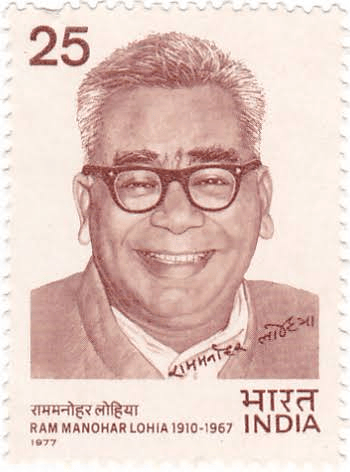
Born in Faziabad district, United Provinces, in 1910 and son of an active nationalist and follower of Gandhi, Lohia pursued his initial studies in Bombay, Benares and Calcutta before travelling abroad to pursue a degree in higher education. His departure from India, in late 1929, coincided with the return of the young JP from the United States. Lohia initially travelled to London, but soon decided to leave the capital of Empire for Berlin, an important point of communist effervescence as well as a ‘centre of Indian intrigue’(26) frequented during the previous years by anticolonial revolutionaries such as M.N. Roy and Virendranath Chattopadhyaya. Although the motivations behind his choice of Berlin over London remain unclear the unusual decision presents us an image of young Lohia as a man ‘imbued with the spirit of discovering a new world, which was not bounded by Thomas Cook, Ballard Pier, Tilbury Docks, Gower Street, three or four years in England and back.’(27)
Both California in the early 1920s – the time of JP’s arrival – and Berlin during the late part of the decade were relevant centres of anticolonial activity, involving the agitation behind the creation of the Ghadar party in the first case, and that of international communist revolutionaries in the second. However, the experience of Lohia as a student abroad was very different from that of JP. Unlike JP, Lohia never thoroughly discussed this period of his life, nor wrote about it; nevertheless, there is enough evidence to trace a few relevant distinctions between the international experiences of the two young socialists. For one, it is possible to assume that, unlike JP – who was employed in a wide variety of activities, form packing vegetables to selling complexion creams to African-Americans(28) – Lohia remained a full-time student in Berlin, since it was not allowed at the time for foreign students to be legally employed in Germany.(29) Further, JP enjoyed great physical mobility in the United States, while Lohia seems to have remained in Berlin for the length of his stay abroad. Likewise, the subjects of their dissertations were very different and revealing of their later intellectual and political inclinations: JP wrote on the theoretical and abstract subject of ‘Cultural Variation’ and discussed the different approaches to truth and knowledge across different cultures(30); on the other hand, Lohia’s dissertation versed on the very specific and grounded issue of salt taxation in British India.(31) Finally, while JP admitted to his fascination and intellectual engagement with Marxist thought during his stay in the United States, Lohia seems to have been less constrained by Marxism and more open to different strands of thought while in Germany, as is made clear by his own testimony: ‘I did not like the German Socialists, but my intellectual kinship was with them. Emotionally, I was with the communists for their warm-heartedness and the Nazis for their anti-British passions, which were to me at least pro-man passions.’(32)
Following his return to India in 1933 and imprisonment shortly thereafter, Lohia became part of the founding group of the CSP. Throughout the 1930s he acted as editor of the party’s periodical, the Congress Socialist, and remained one of the most important organizers of the Left Wing of the Congress. During that time, Lohia distinguished himself from most of his socialist colleagues by his open anti-elitism, managing to irritate and antagonize a few of them with his unconventional demeanour. Madhu Limaye credits Narendra Deva, senior member and first president of the CSP, with reprimanding Lohia for wasting too much ‘time in the company of lafange (riff-raff) at the Coffee House.’(33)
Apprehended during the Quit India agitation, Lohia once again shared imprisonment with JP inside the Lahore Fort, where both friends were subjected to torture and solitary confinement. The experience generated a strong bond of closeness between them that would gradually dissolve during the first years of the 1950s. After the transfer of power, both of them were opposed to the transformation of the Congress into the party of government; however, while JP committed himself to a non-statist project of opposition encompassed under the tag of Lok Niti, Lohia decided to take the road of party opposition and became the leader of the Socialist Party, formed in 1948. Having secured 12 seats in the Lok Sabha during the first general elections of 1951,(34) the vote share of the Socialist Party would steadily decline during the following years. Despite Lohia’s attempts to form alliances with different leftist forces, his parties remained unable to challenge the potency of the Congress or the communists in electoral terms until his death in 1967.(35)
The poor political performance of Rammanohar Lohia as the leader of different socialist parties during the 1950s and early 1960s contrasts with the novelty and audacity of his thought. Lohia managed to develop a potent critique of the shortcomings of orthodox Marxian thought as well as an original philosophy of history, and a programme for an original form of socialism for India. More than any other socialist leader of his time, he reflected upon issues of caste, gender, language diversity and vernacular knowledge in the course of his intellectual development. His focus on the specificities and concrete needs of Indian society, however, did not prevent him from taking into consideration the contingencies of the international arena and devising a plan for a global Parliament. His open-ended vision of socialism was shaped by an awareness of international events, as well as by the deeply felt need to go beyond what he considered the elitism of Nehruvian statist modernization and the potentially violent programme of Indian communists.
Lohia expressed his belief in the need to bring about a new civilization that could overcome the failure of modern Western civilization, which had reached its limits with the invention of the atom bomb and had ‘enveloped the world with fear and hatred.’(36) His vision of the future emerged from a fundamental criticism of Marxism’s incapacity to think through the constitutive relationship between capitalism and imperialism. Unlike JP, who during his youth and early years as leader of the CSP had remained a convinced Marxist, Lohia would very early on denounce the limitations of applying Marxian principles to non-Western and colonial settings. In his essay ‘Economics after Marx,’ written during the Quit India movement while in hiding from the colonial authorities, Lohia observed:
Marx’s initial fallacy was to have examined capitalism in the abstract, to have wrenched it outside of its imperialist context. Marx was not unaware of imperialist exploitation and his disciple, Lenin, was even more keenly aware of it. But, imperialism is with both Marx and Lenin a tumour of capitalism, an odorous after-growth and this has at best awakened an unintelligent concern for the colonial races. Marxism has therefore not been able to give a consistent theory of capitalist development. Its picture of capitalism is that of a West European entity (and) a self-moving West European circle.(37)
Lohia vehemently denounced Marxism as Eurocentric and thus as a doctrine unable to account for the link between capitalist accumulation and colonialism, as well as the existence of what he termed internal capitalism in countries like India, a phenomenon that caused similar socioeconomic imbalances and inequalities to arise within the country as those observable between the country and its former colonial metropolis.(38) However revolutionary it might appear as a doctrine, he argued, Marxism remained tied to a colonial logic that favoured the preservation of the ‘the status quo, at least that part of the status quo which means European glory.’ In this sense, Lohia assured that ‘(t)he effort of Marx was, after all, a colossal construction of the mind to keep the smile on the visage of Europe ever dancing.’(39)
Lohia’s critique of Marxism also entailed a revision of the teleology of historical materialism. In a broader sense, Lohia wanted to point out the way in which ‘such abstractions as capitalism, communism or even socialism’(40) took the history of Europe as their implicit reference and were thus useless in non-Western settings. He was deeply worried about the possible harmful results of implanting such a partial historical and political logic to a non- Western setting such as India. In this sense, he warned that in India ‘any attempt (…) to achieve the modern civilisation, which the world has known for the past 300 years, must result in barren cruelty, cruelty which knows no success.’(41)
His objections to Marxism were complemented by his open critique of the ‘leadership of sterile Marxists’ in recently decolonized countries, a group in which he included Nehru and his fellow champions of Non-Alignment during the late 1950s, Nkrumah and Sukarno.(42) In Lohia’s view, the rulers of the newly created countries of Asia and Africa had ‘arrested revolution’ in their lands by adopting the ‘mode of modernisation of the consumption of their elite, before they (had) modernized the production modes of their masses.’(43) In this way the ‘criminal luxury and waste’ of the national elites was hindering the possibility of a true revolutionary change towards greater social equality and perpetuating ‘natural greed and indolence’ in these countries. In an early formulation of later subalternist and postcolonial critical positions, Lohia observed in 1958 that:
Post-freedom India is but a strict continuance of British India in most essential ways. The Indian people continue to be disinherited. They are foreigners in their own land. Their languages are suppressed and their bread is snatched away from them.(44)
In order to avoid the cruelty that would result from implanting a foreign model of Marxism in India, Lohia pointed towards the need to create a new kind of socialism, equidistantly separated from Marxian communism and Western capitalism. He referred to this position as the principle of equal irrelevance. In this sense, he declared that the likely ‘debacle of capitalism and communism is easily understood when they are viewed as parts of a single civilization that appears to have neared the end of its voyage.’(45) Lohia’s new socialism required going beyond ‘mind-imperialism’ and awakening those ‘colonials of the mind’ that unknowingly perpetuated the power of the privileged and the hostility of the underdog.(46) For this, it was necessary to identify the possibility of alternative sources and points of origin for a new socialist civilization. Following a line of thought similar to that of JP after his imprisonment at Lahore Fort, Lohia identified Gandhi as the only original political thinker of the twentieth century, and saw in Gandhian thought the seeds for a new brand of revolutionary socialism.
Like JP, Lohia exalted Gandhi’s anti-statist stance on social transformation and defended socialism as the only viable political option for independent India. However, Lohia’s appropriation of the revolutionary potentialities of socialism was radically opposed to that of JP. While the latter had come to think of socialism as the result of a moral transformation of society effected through an emphasis on self-sacrifice and non- statist voluntary action, for Lohia socialism remained defined as a horizon structured by the possibilities of statist political action and modern technology. In other words, Lohia never rejected the imperative of acting in the sphere of power defined by JP as Raj Niti; rather, he sought to revolutionize it through an appreciation of India’s specific conflicts and possibilities and a vocal opposition to the Nehruvian project of economic development. For this reason, Lohia remained active in party politics and openly chastised JP for his retreat into Lok Niti. For Lohia, and here we find a rare coincidence with Nehru’s position, socialism had to be promoted from the state.
4. Two socialist critiques of the development project of the Nehruvian State
During the 1950s and 1960s both JP and Lohia deployed sustained attacks on the national state’s policies of economic development, which they conceived of as the noxious result of the elitism and excessive reliance of Nehruvian socialism on Western models. Both expanded their critique by invoking the socialist trope of a new civilization and by appealing to Gandhi’s stance on economic decentralization and rejection of ‘satanic’ modern civilization. This resulted in two powerful socialist critiques of the Nehruvian state’s development project: Lohia’s critique stemmed from a revolutionary approach to modern technology, while JP’s emerged from a spirited defence of village development.
Starting in 1951, even before his retreat from Raj Niti, JP had made clear his defence of the village as the only possible starting point of true socioeconomic change. In a speech delivered at Dekuli, Bihar, in March 1951, JP referred to village-based voluntarism as the only option available to counter the harmful elitist policies of the national state. ‘The village,’ he pronounced, ‘is ours.’ Given that ‘Pandit Nehru will not come to our villages for building roads and doing sanitation work’ he went on speaking to the villagers, ‘you should build roads and plant trees on their sides, which may be used as fuels.’(47) Village-dwellers, he concluded, could not expect to receive any help from the state, and should instead take the issue of economic development collectively into their own hands. JP saw community development as a fundamental prerequisite for the successful and inclusive economic development of independent India. The villages had to be transformed into ‘self-governing, self-sufficient, agro-industrial (…) local communities’ that could form the basis for a ‘meaningful, understandable (and) controllable’(48) socioeconomic dynamic capable of resisting the onslaught of centralization and bureaucratization. In short, community development meant going beyond a concern with ‘industrial development, education, communication and electrification’ and focusing on the ‘the development of the spiritual community (and) of a climate in which families living in rural communities might come together to live a cooperative life.’(49) JP’s message to the villages of India was complemented by an appeal to the elites of India, in which he advocated for a voluntary limitation of wants that amounted to a ‘rejection of materialism or the unlimited pursuit of material satisfaction.’(50) However, despite being coherent with his overall project of anti-statist opposition, JP’s stance on economic development remained fuzzy and ill defined, and did not go beyond the promotion of Gandhian notions of trusteeship and decentralization. His approach to economic possibilities was shaped by his conviction of the importance of Lok Niti, and thus remained limited by the latter’s undefined and broad logic.
Despite sharing JP’s insistence on the importance of simple living and his rejection of the wasteful luxuries promoted by industrial capitalism, Lohia was not interested in drawing upon Gandhian notions of trusteeship or village self-sufficiency. Instead, he pushed Gandhi’s early critique of modern civilization by insisting on a revolutionary approach to the potentialities of technology for the transformation of human society. Lohia described modern civilization, whether communist or capitalist, as a ‘complex consisting of production of remote effect, tool of remote production, democracy of remote second-rate application and even class struggle of remote justification.’(51) This modern civilization, he argued elsewhere, was based on the construction and extensive use of ‘monster-machines,’ designed to remain beyond the reach and comprehension of the ‘common man’ and which remained ‘palpably connected with the waste’ and ‘uneconomy [sic]’ of war.(52) In the political sphere, a reliance on such monster-machines perpetuated the hidden imperialisms inside a country like India, and promoted the thriving of Euro-American superiority on a global scale. This industrial model of economic development, Lohia posited, remained unquestioned by the two struggling systems of capitalism and communism. In this sense, he added, ‘Mr. Ford and Mr. Stalin share(d) each other’s attitudes on mass production and efficiency and high wages.’(53) In India, the pursuit of this shared dream of limitless industrialization was reducing men to the state of beasts and turning postcolonial toilers into mere ghosts ‘invisibly moving the machines in imperial factories.’(54)
Lohia’s alternative to the harmful effects of these monster-machines and industrialization was articulated by bringing together the Gandhian insistence on economic decentralization – also defended by JP – with the original concept of the small machine. Despite never having fully developed what it entailed in practical terms, it is possible to extract the general principles of what Lohia meant by small machine from an analysis of his writings during the 1950s and early 1960s. In broad terms, Lohia used the formula to refer to the development of a brand of decentralized industrial production aimed at the attainment of village autonomy – instead of self-sufficiency. In this sense, he was not advocating for a mere revivalism of cottage industries or a celebration of the autarkist village. In his view, the questioning of technology did not necessarily have to entail relying on handicrafts and village markets. Thus he declared that the
basic problem (was) not to cut down the use of mechanical or electrical power but to make it available for production in the same small units in the manner in which it is available today for consumption in prosperous economies.(55)
In this sense, he was arguing for a revolutionary approach to technology that did not aim at an ever-increasing margin of material profit but rather at the liberation of mankind:
The only way to overcome industrial and scientific inequalities among nations would be (…) through the ushering in of a new civilization and a new technology. The materialist bull we dare not slay. Futile revivalists of cottage craft would alone attempt that, more in speech than in action. The materialist bull will have to be fed but held by the horns, so that a doctrine that combined truth with pleasure could be evolved. Small-unit machines, wherever possible, and mass production, whenever necessary, is a formula than which nothing more exact is possible.(56)
Lohia’s harsh rejection of the ‘barren cruelty’ of simplistic implantation of foreign models can be seen as an attack against the Nehruvian model of industrialization, which, in his view, would condemn India to second-rate capitalism and contribute to the unending political superiority of the West. At the same time, Lohia’s concept of the small machine as an alternative to industrial process of economic development links to a broader preoccupation with the hierarchy of knowledge implicit in the Nehruvian project, which denied the validity of people’s knowledge in favour of the knowledge of experts.(57) The new socialism Lohia pursued had not only to fundamentally rethink the foundations of Marxism, but also to challenge the supremacy given to Western forms of knowledge in postcolonial countries. This was urgent in order to interrupt the hierarchical tradition of deshmukh leadership, the epistemological foundations of which were left untouched by JP and openly defended by Nehru.
Taking this into consideration it is possible to distinguish a fundamental distinction between the socialist outlooks of JP and Lohia. While the former’s socialism was defined by the need to promote freedom from the alienating effects of power – both political and economic – Lohia’s project was based on a different principle: that of equality. It is to this fundamental divergence that I now turn.
5. Caste, inequality and the limits of Lok Niti
JP’s reliance on the potential of popular power was at the root of his project of Lok Niti and entailed an acceptance of the hierarchies found within the collective, notably that of varna, which, he argued, was as ‘natural’ as a ‘communion with neighbours.’ This defence of varna was consistent with JP’s ideal of Lok Niti, in as much as he conceived of the former as a ‘sign-post’ of an original, ‘stable (and) democratic basis for (an) Indian polity’ in which ‘the dharma, or social ethics, continued to function independently of the central State.’(58)
Towards the end of the 1950s, JP made clear his central concern with the problem of freedom. In this sense, he declared the strife for ‘freedom of the human personality, freedom of the mind (and) freedom of the spirit’ as the leading ‘beacon’ of his life and the driving force of his political activity.(59) The state, he argued, was the greatest obstacle for the attainment of this freedom; alienation could only be overcome through active political militancy, the defence of socialism – by then thought of as a programme for the creation of a dharmic human community – and a strife to re-empower people in the face of power. In this sense, JP participated of a romantic and anti-totalitarian narrative of revolution, marked by vindicationist narratives of freedom and emancipation from injustice widely shared in different regions of the globe among intellectuals and progressive activists during those decades.(60) For this reason, JP’s project of Lok Niti, focused as it was on promoting an oppositional project based on the rejection of the vices of the state in favour of an intrinsically virtuous and potentially revolutionary multitude, could not but remain uncritical of the vices and shortcomings of the lok which it extoled and defended.
In contrast, instead of being fuelled by the prospect of freedom, Lohia’s politics hinged on the promotion of greater equality for the people of India. Lohia fierce critique was directed at what Anand Kumar has termed the matrix of power in Indian society, shaped by the intersection of the hierarchical inequalities of caste, class, gender and language.(61) Lohia estimated that roughly 90% of the people of India were, in one way or another, victims of injustice as a result of the graded structure of inequality intrinsic to its society.(62) As a result, he did not focus solely on denouncing the corruption and misused power of the higher spheres of politics, but also, and more vigorously, attacked the social elites of India, the members of which, he claimed, could be identified by sharing two of the three following features: high-caste, an English education and material wealth.(63)
The project of socialism defended by Lohia during the 1950s and 1960s incorporated this intersectional approach to inequality and focused on the shortcomings of society rather than the vices of the state. If JP’s project Lok Niti relied on building up the assumptions behind Swadeshi articulations of the virtues of the multitude,(64) Lohia, in contrast, described traditional Indian society as ‘caste-ridden and as frightened of change as it (was) devoid of hope’ and attacked it for being fundamentally un-revolutionary.(65) Consequently, Lohia voiced his intense opposition to JP’s Gandhian vision of the village and the virtuous multitude, and remained highly sceptical of the extolment of the lok as an alternative for the state. In stark contrast to JP, Lohia described the people of India as ‘the saddest on earth,’ and spoke of a ‘black sadness’(66) that prevailed over Indian society as the result of the despairing immobility of its structures of segregation, which were perfectly exemplified by caste. According to him, it was precisely the immovable character of caste that distin- guished it from class. ‘Class,’ he argued, ‘is mobile caste. Caste is immobile class.’(67) Caste, however, was not a purely Indian problem, but appeared as the result of a universal social dialectic inspired by the demand for equality. Indeed, for Lohia the movement of history was determined by this constant oscillation between the rigidity of caste and the suppleness of class.(68)
Lohia’s rise to prominence as the leader of party socialism coincided with a period of intense debate around the issue of caste-based reservations. Even before the appearance of the First Report of the Backward Classes Commission, written in 1953 and published in 1955, Lohia had advanced his interest in involving members of the lower castes in the ranks and leadership of the Socialist Party, and had begun his active campaign for the application of preferential opportunities for the backward sections of society. During the second half of the 1950s, Lohia advocated for at least 60% of the ‘nation’s top leadership’ to be selected from among the lower castes. However, unlike Ambedkar, Lohia advocated for extending the scope of the Backward Classes label to include other sections of the population, notably depressed Muslims, Adivasis and women.(69)
Equality was not, like freedom, a goal to be attained through the militant belief on a romantic and teleological narrative of vindication and liberation. Rather, it was a never- ending process that had to be constructed gradually through the revolutionary effect of the action of the state upon an un-revolutionary and unjust social order. In this sense, Lohia’s position, in as much as he denounced the conservative and hierarchical core of the lok or people of India, can be seen to be diametrically opposed to JP’s anti-statist socialism. By stressing the intrinsically un-revolutionary nature of society in India and promoting a programme of political change based on the radical demand for equality, Lohia was in fact, making a case for the impossibility of a multitude as the basis for political action and, as a result, for the inherent faults of the project of Lok Niti.
6. Indian socialisms and the emergence of new radical trajectories
The gradual separation between JP and Lohia during these years was the result of irreconcilably different conceptions of the possibilities of political action, the role of the state and a disagreement over the relation of socialism to the notion of social revolution. Both of them, as we have seen, identified socialism with the possibility of a radical transformation of society and, through it, the coming of a new civilization. As a result of their differing conceptions of revolution, however, the shape and possible outcomes of this transformation were imagined in entirely different ways by each of them. In this final section, their differing conceptions of socialism and revolution are contrasted with the position defended by Nehru, promoter of an ambiguous socialistic pattern of development for India and, for many across the world, one the most important promoters of Non- Aligned socialism.
For Nehru, the goal of socialism was to be subjected to the broader project of modernization and industrialization. In the spirit that animated the project of the Third World – captured in the title of Julius Nyerere’s biography We Must Run While They Walk – the revolution of socialism was coded by Nehru in the language of state-led economic growth. On the other hand, for JP, especially following his drift towards Lok Niti and his equation of socialism and Sarvodaya, the revolution of socialism had to be effected through the promotion of a politics of moral transformation capable of going beyond materialism and the alienation caused by modern civilization and the modern state. Finally, and in accordance with his intersectional approach to social inequality, Lohia developed a project of transformation based on what he termed the seven revolutions – Saat Krantiyan. These included the fight against the four kinds of inequality predominant in India – namely, and in that order, those of gender, caste, class and race, the fight against the inequality between nations, the revolution against the infringement of the individual by the collective and the promotion of a revolutionary practice based on civil disobedience.(70)
Despite being invested in a form of socialism that could fit the specific needs and problems of independent India, both Nehru and Lohia shared a common international outlook, which contrasted with JP’s more provincial and individual focus. JP sought to extend the autarkic principles of Swadeshi nationalism and Gandhian nativism, for the sake of a ‘Total Revolution’ capable of affecting the foundations of life itself. On the other hand, both Lohia and Nehru struggled to make socialism in India relevant and attuned to the events taking place in a wider international setting. In this sense, for Nehru and Lohia, revolution was a global project. However, while Nehru became one of the main promoters of Third Worldism, Lohia was deeply critical and suspicious of his politics and those of other postcolonial national leaders. The great convulsion brought about by decolonization, he assured, had not resulted in the triumph of a revolutionary change towards greater equality: ‘No spectre,’ he declared in 1966, was ‘haunting the world or any part of it.’(71)
At the same time, while JP literally renounced the state, both Lohia and Nehru were deeply invested in its importance for the promotion of a socialist revolution. For JP, socialism had to transcend the increasing statism that sought ‘to reduce the people to the position of sheep’ and carry on the impulse of Swaraj.(72) Nehru, for his part, became increasingly impatient with anti-statist protest during the 1950s, which he branded as an ‘immature’ and ‘absurd’ political practice and conducive to the weakening of the nation.(73) For his part, Lohia saw all initiatives to promote social transformation from outside the state as doomed to failure. Both Nehru and Lohia conceived of the national state as the product of the triumph of anticolonial nationalism, and as the main tool for the transformation of society. Nevertheless, their projects of socioeconomic development could not have been more at odds with each other. Nehru’s conviction that modernization through industrialization would lead India out of material poverty and put an end to unjust social structures was harshly criticized by Lohia, who actively advocated for caste reservations and the promotion of the revolutionary technology of the small machine.
Finally, beyond the formal and conceptual differences between these positions, it is important to note the ways in which they participate in opposed conceptions of revolution. During the 1950s and early 1960s, both Nehru and JP acted on the conviction that ‘(t)he world (was) moving towards Socialism,’ that ‘the message of Socialism (was) the message of history,’74 and that this marked a ‘slow but sure’ progress of man ‘from barbarism to civilization.’75 Lohia, on the other hand, had a pronounced non-teleological view of history, which he conceived of as cyclical and thus inevitably marked by perpetual instability and flux. Unlike JP or Nehru, Lohia could see no evidence to hint at the possibility of an ascending or linear progress in the movement of history. Unlike the event of freedom that JP longed for, or the moment of modernization that Nehru dreamt of, for Lohia socialism could only emerge as the result of a never-ending process that had to be constructed gradually through the revolutionary action of the state upon an un-revolutionary and unjust social order.
These ideological and conceptual differences would crystallize in the final and irremediable estrangement of the three most important socialists of early independent India. This process would be complemented by an open political confrontation between the three leaders. During the 1950s, it was clearly Nehru’s ideal of socialism that emerged victorious from this battle over meanings. At the same time, however, JP and Lohia were crucial figures in the establishment of socialism as an important category for protest at a time, the 1950s, in which socialism was being domesticated as a central part of the roadmap for socioeconomic development of the national state across the Third World. Despite the fact that their ‘battle over meanings’ did not materialize in significant immediate gains for either JP or Lohia, it created a space for the emergence of original conceptions of socialism wholly unrelated to anything known elsewhere by that name. In later years, their opposing ideas of socialism would play out as part of the agitations of the JP Movement, the debates on caste reservations, the growth of the NGO sector, and the consolidation of important political parties such as the Janata Dal (United) and the Rashtriya Janata Dal.
Beyond India, both Lohia and JP were path breaking critics of Third World nationalism and its wielding of early twentieth century anticolonial utopias, especially regarding the ambiguities of sovereignty in the new nations and the harmful implications of statist developmentalism.(76) Rammanohar Lohia must be seen as a precursor to postcolonial and sub- alternist critiques, as well as of influential debates taking place in academia and outside it regarding the importance of epistemic justice(77) and affirmative action. For his part, in JP’s socialism it is possible to find traces of an early example of the brand of politics that expanded across the globe following decolonization in Asia and Africa, and which, in sharp contrast to earlier political utopias, focused primarily on the promise of anti-politics, the potency of the social and the potential of morality.(78) As a result, the battle over meanings that engaged JP and Lohia in the 1950s must be seen as a crucial moment in the inauguration of a set of political trajectories central to the contemporary political and intellectual horizon of India, as well as a particular stance of wider intellectual processes taking place during the 1950s and 1960s that would radically transform the global landscape of progressive and radical politics after the 1970s.
Notes
1. Nyerere, Ujamaa: Essays on Socialism, 1.
2. Guevara, “Socialism and Man in Cuba.”
3. Nehru, “Speech at the All India Congress Committee,” in Ghose, Socialism and Communism in India, 206.
4. Chakrabarty, “Legacies of Bandung.”
5. Narayan, “To Students. 1943,” in Jayaprakash Narayan: Selected Works, Vol. 3, 135.
6. Cited in Scarfe and Scarfe, J.P. His Biography, 52.
7. Nehru Memorial Museum and Library Oral History Archives, cited in Jani, “Bihar, California and the US Midwest,” 163.
8. Narayan, “The Task Before Us,” in Jayaprakash Narayan: Selected Works, Vol. 2, 205.
9. Narayan, “Speech at a meeting of Muslims,” in Jayaprakash Narayan: Selected Works, Vol. 4, 193.
10. Narayan, “Letter to the General Secretary of the AICC,” in Jayaprakash Narayan: Selected Works, Vol. 1, 70.
11. Narayan, “Comment on Vallabhbhai Patel’s Speech,” in Jayaprakash Narayan: Selected Works, Vol. 1, 69.
12. Narayan, “Why Socialism?” in Jayaprakash Narayan: Selected Works, Vol. 2, 50–62.
13. Narayan, “In the Lahore Fort,” in Jayaprakash Narayan: Selected Works, Vol. 3, 195.
14. Narayan, “The A.I.C.C Session.”
15. Narayan, “Annual Report of the General Secretary,” in Jayaprakash Narayan: Selected Works, Vol. 4, 236.
16. Ibid., 241.
17. Ibid., 240.
18. Narayan, “Reply to the debate,” in, Jayaprakash Narayan: Selected Works, Vol. 4, 246.
19. Narayan, “The Fast,” in Jayaprakash Narayan: Selected Works, Vol. 6, 251.
20. Scarfe and Scarfe, J.P. His Biography, 273.
21. JP’s first use of the term is found in “Jeevandan,” published in Janata, 27 June 1954.
22. Narayan, “The Fast,” 251. 23. Ibid., 245.
24. Ibid., 247.
25. Ibid., 251.
26. Anonymous, “Indian Communists. Reports from 21 November 1922 to 10 May 1923” in Zentrum Moderner Orient, Krüger Nachlass Annex, Berlin (ZMO-A): Item 41, in Manjapra, M. N. Roy, 76.
27. Mirza, Welcome Each, xii, in Oesterheld, “Lohia as a Doctoral Student in Berlin,” 86.
28. Scarfe and Scarfe, J.P. His Biography, 59–60.
29. Oesterheld, “Lohia as a Doctoral Student in Berlin,” 86.
30. Narayan, “Cultural Variation,” in Jayaprakash Narayan: Selected Works, Vol. 1, 1–40.
31. Oesterheld, “Lohia as a Doctoral Student in Berlin.”
32. Kelkar, Dr. Rammanohar Lohia, 77.
33. Limaye, Galaxy of the Indian Socialist Leaders, 85. Parenthesis in original.
34. Election Commision of India, “Statistical Report on General Elections.”
35. Lohia was an important figure of the Praja Socialist Party (1952) and the Samyukta Socialist Party (1964). For more on the trajectories of these parties see Fickett Jr., “The Major Socialist Parties of India” and “The Praja Socialist Party of India.”
36. Lohia, Marx, Gandhi and Socialism, 245.
37. Ibid., 16.
38. Ibid., 26.
39. Lohia, Wheel of History, 23.
40. Lohia, Interval During Politics, 94.
41. Lohia, Marx, Gandhi and Socialism, 109.
42. Lohia, “Revolution Arrested,” 53.
43. Ibid., 52.
44. Lohia, “Caste,” 30.
45. Lohia, “Presidential Address at the Pachmarhi Convention,” 479.
46. Lohia, “On Hidden Imperialisms,” 49.
47. Ibid., 114.
48. Narayan, “A Plea for Reconstruction,” in Jayaprakash Narayan: Selected Works, Vol. 7, 489.
49. Narayan, “Panchayati Raj and Democracy,” in Jayaprakash Narayan: Selected Works, Vol. 9, 34.
50. Narayan, “A Pea for Reconstruction,” 441.
51. Lohia, Wheel of History, 82.
52. Lohia, Marx, Gandhi and Socialism, iii.
53. Lohia, “Presidential Address at the Pachmarhi Convention,” 475.
54. Lohia, Marx, Gandhi and Socialism, 24.
55. Ibid., 50. 56. Ibid., 204.
57. Basole, “The Technology Question in Lohia” and Tolpadi, “Context, Discourse and Vision.”
58. Narayan, “A Plea for Reconstruction,” 451.
59. Narayan, “From Socialism to Sarvodaya,” in Jayaprakash Narayan: Selected Works, Vol. 7, 227–9.
60. For more on different narratives of revolution during the second half of the twentieth century, see Scott, Conscripts of Modernity, 70.
61. Kumar, “Understanding Lohia’s Political Sociology.”
62. Lohia, The Caste System, in Kumar, “Understanding Lohia’s Political Sociology,” 65.
63. Lohia, Wheel of History, 106.
64. Chakrabarty, “In the Name of Politics.”
65. Lohia, Marx, Gandhi and Socialism, xxv.
66. Lohia, The Caste System, 1–3.
67. Lohia, Wheel of History, 28. 68. Ibid., 42–3.
69. Lohia, The Caste System.
70. Lohia, Marx, Gandhi and Socialism, xxx–xxxx.
71. Lohia, “Revolution Arrested,” 51.
72. Narayan, “From Socialism to Sarvodaya,” 245.
73. Nehru, “Students and Discipline,” in Selected Works of Jawaharlal Nehru, edited by Sarvepalli Gopal, Second Series: Vol. 29, 83.
74. Narayan, “Presidential Address at the Second Convention,” in Jayaprakash Narayan: Selected Works, Vol. 4, 200.
75. Nehru, Glimpses of World History, 6.
76. Patel and McMichael, “Third Worldism and the Lineages of Global Fascism.”
77. See, for example, de Sousa Santos, Epistemologies of the South.
78. For a revision of related theoretical and political changes in radical politics after the 1970s, see Moyn, The Last Utopia and Zamora and Behrent, Foucault and Neoliberalism.

The “People’s Movement Left” and Rammanohar Lohia: an evaluation at a time of crisis
June 13, 2009
By Amit Basole,

Sanhati
Simplifying matters somewhat at the present juncture three significant streams of Left political practice can be identified in India: first, the Communist Parliamentary Left or what Dipankar Basu has termed the Social Democratic Left (SDL) which includes the CPM, CPI and their allies, second what may be termed the Communist non-Parliamentary Left (CnPL) which includes CPI (Maoist), CPI (ML) and smaller Maoist Parties and third, the People’s Movement Left (PML), sometimes called the “non-Party Left,” which is also largely non-Parliamentary (though for reasons different from the Maoist Left). PML includes various organizations belonging to the National Alliance of People’s Movements (NAPM) and other related movements (such as the anti- caste movement, the new farmers’ movements).
This essay argues that the socialist tradition that lies behind the PML has much to offer to overcome the shortcomings of the Marxist Left.
The SDL faces multiple crises at this juncture, some of which have been extensively analyzed following its electoral defeat. Whatever may be its failings on the leadership and organizational fronts (and those are many), it is clear that there is a profound crisis of thought also. The SDL suffers from excessive attachment to a Eurocentric and stagist theory of history (wherein industrial capitalism is a necessary step to socialism) and an economic determinist philosophy (which gives short shrift to non-economic forms of oppression and expression). In addition its theory does not allow significant revolutionary agency to peasants and informal sector workers who constitute the overwhelming majority of the working population of India. The demise of the Soviet Union has added to the bankruptcy of thought and the feeling of “TINA.”
The CnPL is also unable to break completely from a Eurocentric form of Marxism and a stagist theory of history, albeit due to its Maoist moorings it is sensitive to an ex-colonial reality not only in practice but also at the level of theory, and recognizes the central role of the peasantry in revolutionary transformation of society. Despite significant experiments in direct democracy as well as economic development in Maoist controlled territories, its strategy of armed struggle and its boycott of parliamentary politics has precipitated a crisis of its own as the State retaliates in a violent manner, and the working population is caught between the two. The ensuing cycle of violence has claimed many lives and within current praxis there does not seem to be an end to it. Furthermore, arguably the abdication of the Chinese leadership to a particularly vicious form of industrial capitalism may have contributed to a muddying of the CnPL’s vision for a future Indian society.
The PML has risen to prominence in the 1980s and 90s, as the Soviet and Chinese experiments were running their course. It is thus less burdened with their failures. It is also more rooted theoretically in the Indian political tradition, drawing more inspiration from Gandhi rather than from Marx. It has largely relied on non-violent methods of resistance and some of its ideologues speak of “alternative models of development” in a manner reminiscent of Gandhi’s critique of development. However it seems to lack theoretical coherence since it takes the form of myriad local struggles over jal, jungle aur zameen (water, forest and land). The degree to which a given local movement challenges the established order also varies greatly across the country. Hence it is difficult to ascertain the revolutionary potential of the sum of such movements. Notwithstanding this it has received widespread support from Left intellectuals, academic ones in particular, perhaps because it is unburdened with failures of “actually-existing Socialisms” of the 20th century.
The theoretical backbones of the SDL and the CnPL are well-known. The writings of Marx, Lenin and Mao stand tall in this regard. The theoretical basis of the PML is less clear but in fact has a long and distinguished career in India. This is a type of Socialism that takes not only Marx but also Gandhi seriously and attempts to construct both a political practice and a vision for a future society different from orthodox Marxism. In this article I will use Rammanohar Lohia’s writings as an example of this tradition.
Lohia is an unjustly neglected figure in the Indian political tradition. To the extent that people are familiar with him, they either know him as Gandhi’s disciple or perhaps as Nehru’s critic in the 1960s and if they are familiar with some socialist history, as Jayaprakash Narayan’s co-worker in the Socialist wing of the Congress and later a leader of the Socialist Party. In fact Lohia was a highly original thinker who had something interesting to say on questions as diverse as mode of industrialization, possibilities for an India-Pakistan Federation and the “national language” question in India. He is also someone whose world-view is most in harmony with the PML. Below I highlight some crucial aspects of Lohia’s thought that are helpful to us in charting a way forward.
Lohia is an atheist and a materialist who takes Gandhi’s critique of modernity seriously. He believes, as Gandhi did, that the promises of modernity are only for making and not for fulfilling. Gandhian ideas of non-violence and inseparability of means and ends also influence Lohia’s thinking. Yet, from his early years in Germany, Lohia is also deeply influenced by European socialist traditions in which Marx looms large. From Marx Lohia takes materialism and class, but rejects his theory of history and progress. If Ram Guha’s assertion that “inside every thinking Indian is a Gandhian and a Marxist struggling for supremacy” is correct, in Lohia the two are hybridized in a fecund manner. However, characteristically Lohia himself rejects any suggestion that he tries to combine Marx and Gandhi and says: “Socialism does not need to claim either that it is Marxist or Gandhian, nor that it is anti-Marxist or anti-Gandhian.” In Lohia’s hands Gandhian theory and practice acquired a far more radical edge. Distinguishing himself from the “official Gandhism” of the day (and people like Vinoba Bhave) Lohia jokingly referred to himself as a “kujaat Gandhivaadi” (low-caste Gandhian).
Another significance of Lohia’s elaboration of Gandhi’s ideas is that he is far more well-acquainted with the European socialist traditions than Gandhi ever was and as a result may be more approachable to those who are unwilling to take Gandhi seriously only because he was unacquainted with Marx
Eurocentrism:
Arguably most Indian political thinkers with some mass following have thought within European modernist paradigms, ways of thinking about society that reached their culmination in 19th century Europe. This includes “indigenist” (“swadeshi”) thinkers on the Right who do so unwittingly. Prominent exceptions are Gandhi and later Lohia. Of the modernist paradigms, Liberalism and Marxism in particular have profoundly influenced Indian thinkers. Marxist thinkers, despite their radical aspirations, have been mostly unable or unwilling to shake of the modernism of Marx, which in keeping with its time viewed the world from the point of view of Europe, and measured progress as a process of Europeanization of the non-European world. The advent of postmodernism in the Euro-American and later the Global Academy has served either to seduce some Marxists to postmodernism or to harden Modernist positions among others. It is not clear yet if postmodern Marxists can create a different socialist vision for the 21st century.
In his books “The Wheel of History,” and “Marx, Gandhi and Socialism” (of particular interest is an essay titled “Economics After Marx”) Lohia challenges the Eurocentrism of orthodox Marxist accounts of History. He notes that the vast majority of humanity has only a secondary place in a narrative centered largely on the “Rise of Europe.” Further he challenges a narrative of progress which only recognizes the adoption of industrialism in either its capitalist or (then) communist forms by the colonies as progress. Struggling to keep history open-ended and the fate of post-colonial societies in their own hands Lohia notes:
“Capitalism and Communism are two completely elaborated systems and the whole world is in their grip. The result is poverty, war and fear. A third way of thinking is also making its presence felt on the world stage. It is still insufficient and has not been completely elaborated, but it is open-ended. An open system retains the possibility of truth and progress, while in a closed system facts are treated violently, declared meaningless and cast aside.”
Mode of Development:
Along with the question of Eurocentrism, the question of the type of economic development was Lohia’s most fundamental theoretical challenge to Marxism. Marxists have been by and large unwilling to confront the possibility that industrialism and not capitalism may be the primary impediment to achieving the good life everywhere on the planet. Dazzled by the spectacle of modern science and technology and seduced by promises of plenty, Marx and later Marxists gave short shrift to two of their own fundamental insights: that history matters and that technology is both a cause and effect of the social relations of production. Assuming that the evils in industrialism (which have never been particularly hidden in its two centuries of existence) would disappear under socialism amounted to forgetting the peculiar historical conditions under which industrialism took shape in Europe and America and overlooking that fact that modern technology is profoundly shaped by capitalist social relations (early Soviet experiments with Taylorism in an effort to increase productivity are a case in point).
Thinkers in the Lohia tradition have long emphasized that the availability of colonies was crucial to Europe’s industrial development and that the non-availability of such colonies for India means a process of internal colonization in the manner that we have seen ample evidence of since 1947. Thus crucially, history has borne out the Gandhian-Lohiaite position on this issue. Marxists and other modernists still find this difficult to accept wholly since it calls into question the very possibility that industrial capitalism in the European manner could take shape in the colonies. And if it cannot, what prospects then for socialism?
Kishan Patnaik, another unjustly neglected figure in the Indian Socialist tradition notes that Lohia returns time and again to the question of technology. In his essay “Gandhi, Lohia and Modern Civilization,” Patnaik quotes Lohia:
“That scientific progress will bring forth an age of plenty is a pitiable thought, one that forsakes intellect. We must consciously build a political and economic structure that bridges the gap between and within nations. Current industrial technology cannot do this- that it can do this is extremely doubtful. This technology originates in very specific circumstances: one low population and abundant land; two, a certain given amount of capital available per capita and developed machinery; three, Western Europe producing industrial goods for the whole world.” (translated from Hindi)
Further Patnaik notes that “In Independent India’s politics Lohia is the only leader whose agenda included the ‘obstinate’ insistence on challenging Nehru’s policy of Westernizing the Indian economy and society as well as organizing the masses to resist it.”
Lohia is able to avoid the “productivity-fetishism” of Marxism because of the influence of Gandhi. Yet by forcefully bringing up the question of class, private property and economic equality, as well as by adopting a stance that is not anti-technology, but rather anti-industrialism, he is better able to deal with allegations that he is merely glorifying poverty. This also means that a “small is beautiful” approach to technology is not taken to be a panacea for the problem of development.
Economic Determinism:
Lohia explicitly rejects economic or class reductionism and accords equal importance to caste and gender oppression. Caste as well as class are center-pieces of his theory of history. And his idea of the “seven revolutions” (sapt-kranti) anticipates “race, class and gender” analyses that are popular today. The seven revolutions are for: gender equality, end to racial inequality, end of caste inequality, end to imperialism and creation of a world government, end to economic inequality based on private property, end to use of arms and institution of the principle of civil disobedience and opposition to encroachments upon individual freedom.
The followers of Lohia have thus found it far easier than Marxists to take caste struggle on its own terms and to recognize that the question of caste cannot be reduced to the question of class.
State:
Lohia also anticipates contemporary notions of decentralized governance although he tempers Gandhi’s anarchist tendencies with a sort of “functional federalism.” His concept of the “four-pillar state” (chaukhamba raj) is a pragmatic attempt to combine Gandhian village democracy with a modern State apparatus, the four pillars being: village, district, state and center. It is important to remember that Lohia was speaking of a decentralized socialist state at a time with such ideas were not part of Left mainstream thought.
A few words by way of conclusion. The foregoing is not intended as a comprehensive survey of Lohia’s thought or as a complete critique of the SDL and CnPL from the Lohiaite perspective. Nor is it meant to be a mud-slinging exercise against Marxists. Rather it is a modest effort to acquaint those who may not be so acquainted with attempts to “Indianize Marx” as it were. Marx has encountered Gandhi in a very productive way over the past hundred years in India. While Communists of various persuasions have not taken Gandhi particularly seriously, the Socialists have done so. This is not an arm-chair intellectual tradition but rather a political one. From Jayaprakash Narayan and Lohia to Shankar Guha Neogi those who have contributed to it have been in the thick of politics. As such it may suffer from theoretical inconsistencies and dead-ends. However, it is a heritage which in attempting to build a new Socialism for the 21st century it would behoove us to engage critically with.
Further Reading:
1. Rammanohar Lohia, Itihaas Chakra (The Wheel of History) Navahind Prakashan, 1963
2. ________________, Marx, Gandhi and Socialism, Navahind Prakashan, 1963
3. ________________, Fundamentals of a World Mind, Sindhu Publications, Bombay, 1987
4. Kishan Patnaik, Vikalpheen nahin hai duniya, Rajkamal Prakashan, New Delhi, 2000
5. Sunil, Nandigram and the Blind Faith in Industrialization, Samayik Varta, June 2007 (original in Hindi, English translation at https://sanhati.com/excerpted/588/)
6. Special Issue of Hindi Journal Samayik Varta (March 2003), Lohia in the 21st Century
7. Blogs: http://samatavadi.wordpress.com and http://samajwadi.blogspot.com
9 Responses to “The “People’s Movement Left” and Rammanohar Lohia: an evaluation at a time of crisis”
- kg.kannabiran Says:
June 20th, 2009 at 01:43Dear freind I am currently President PUCL. Your analysis is interesting. The bridging of gulf between Ganhi and loia. Lohia is a fine thinker but unfortunately appeare to be community of porcupines and therefore could never come closer to each other. They were incapable of sublimating their egos even for peoples cause. kgk - Samarendra Das Says:
June 22nd, 2009 at 07:57Dear Sathi, Your essay is interesting. Hope you will let me know more about your work.People’s movement’s in present state are not necessarily tilt to left as we witness in India. Many of them are filling the vacuum that are created by the lack of “real Left” forces and now replaced by a mixture of ngos,reactionary forces along with a lot many free floating individuals mostly disilluioned by the present day politics.I agree what thinkers like Kishen Pattnayak saw in the real potential behind the people’s movement.
After reading Deepankar’s essay in the EPW on the SDL I think we still need to look at the people’s movements of other countries.
One such example can be the recent events that are unfolding in Peru..
Samarendra
sdasorisa@rediffmail.com
PS: One small correction in your essay Kishan should be spelt as =Kishen - K.Sekhar Says:
June 28th, 2009 at 15:31Lohia more than any other leader in free India resisted hegemony of every kind.He was a great sensitizer as well as mobilizer. Non-conformist to the core he always galvanised the public to fight even the slightest encroachment on their rights.His non-violent methods of resistance and advocacy of representations and social justice need to be emulated.You are right in saying that he has been unjustly neglected in Indian politics. - vijayaraghavan cheliya Says:
February 9th, 2010 at 12:43dears
i went through your words. i am also very interested to learn lohias thoughts.
vijayaraghavan cheliya
secretary, lohia vicharavedi
Edakkulam,Koyilandy
kozhikkode,kerala-673306
phone-0496-2688310 - Anand Kumar Says:
February 28th, 2010 at 03:44This is an impressive synoptic view of Dr. Lohia’s ideas. You will do justice to your purpose by providing a little more material under the sub-headings of Caste and class;Gender, Caste, Class and socialism,Technology and a socialist civilization, Revolution and Satyagraha way. You have created a good comparative view for a broad spectrum of readers from the Marxists and Maoists to Gandhians. This is Lohia Centnary Year. may I urge you to go further and give us more of your understanding of Lohia ideas and their significance. Here is already a good synopsis for a first rate book on Lohia. - edayathsreedharan Says:
March 1st, 2010 at 11:13iam very pathetic that their is no socialaist movement to carry the principles and ideas - ghanashyam sonar Says:
November 15th, 2011 at 06:54amit tuze article marathit aahe? mode of production relation article epw madhye pahile ajun opinion dyayache aahe, shyam sonar shyam.panther@gmail.com - Sunil kumar Says:
November 7th, 2014 at 03:03Mujhe Lohia saptkranti& itihas chakra chaiy .Navahind prakshan ka Chautauqua.Kai se milega. - K.p.sharma. Says:
December 26th, 2017 at 04:11Please help me to get lohia book on chaukhamha and sapt kranti.
Lohia’s realization of a vibrant and active Gandhi

02/10/2026

“The greatest revolution of our time is, therefore, a procedural revolution, removal of injustice through a mode of action characterised by justice. The question here is not so much the contents of justice as the mode to achieve it. Constitutional and orderly processes are often not enough. They are then transgressed by the use of weapons. In order that this should not happen and that man should not ever get thrown around between ballet and bullet, this procedural revolution of civil disobedience has emerged. At the head of all revolutions of our time stands this revolution of satyagraha against weapons although it has in actual effect made only a faltering appearance to date.”
– Dr. Rammanohar Lohia, Marx Gandhi and Socialism
MK Gandhi, who lived a rich life defined by thought and action, has been reduced to a mere photograph and an object of veneration. The contention now centers on who waves Gandhi’s picture more vigorously and who displays greater reverence towards him. (There has been no dearth of individuals or groups in the country who repeatedly fire shots at Gandhi’s photograph and revile him in order to murder him again and again. But that is a separate matter.) In such a milieu, it is pertinent to recall Lohia’s serious endeavor to harness Gandhi’s ideas and mode of resistance for the creation of a new socialist doctrine – one that provides an alternative to the capitalist and communist systems. Both Gandhi and Lohia share a connection with the month of October – Gandhi’s Jayanti falls on October 2nd, while Lohia’s death anniversary is observed on October 12th.
Lohia’s critique of Gandhi has been a significant contribution to the Gandhian studies in the post Gandhi-era. Lohia, as a heretic Gandhian, makes perhaps the most revolutionary interpretation of Gandhi’s philosophy and his unprecedented non-violent mode of protest. After a critical examination of capitalism and communism Lohia finds the whole world in their grip resulting in poverty, war and fear. He proposes the third idea of socialism as an alternative which proceeds by placing the colonized part of the world at the center. He accepts the fact that the idea is not fully elaborated but it is open. According to him, “In an open system there is still some chance of truth and progress, while a closed system does violence to facts and wishes them away in order to prove their meaninglessness.”
Lohia takes fresh initiatives for the construction of a new kind of socialist philosophy and politics much before the Neo-Marxists and the New Left ponder upon the idea. He finds more useful material in the ideas and mode of protest of Gandhi in this venture. According to him the new socialist doctrine would be the basis of a new socialist order in the world which will ultimately lead humanity into a new civilization free from violence and poverty.
Lohia accepts the place of Marx in his tradition but at the same time he clarifies that “…this talk of being a Marxist or an anti-Marxist is futile and irrelevant. What is relevant is correct thinking and integrated approach. Our mind must be on a quest, a quest for the essence that lies under Gandhiji’s or Marx’s thoughts. Quest and not entanglement with tradition can help us to do this.” Lohia refutes a prevalent belief that he tries to mix Gandhi and Marx: “Socialism need not proclaim itself as Gandhian or Marxist on the one hand and as anti-Gandhian or anti-Marxist on the other…”
He further suggests, “… it is not the fault of Marx that people stay put at Marxism.” Lohia criticizes the claimants of Gandhism as well: “It will be countered that what prevails in the country today is not the Gandhi doctrine but a somewhat inferior brew of Gandhism and Marxism. That is substantially correct, but it confirms the weakness of Gandhism in so far as Marxism forces it to mix and also that the best in it is unable to burst forth.”
Lohia wants to apply a filter of Gandhism while theorizing and interpreting the new idea of socialism. Therefore, he does not reject Gandhi’s ideas on truth, time, history, progress, development and even religion. For example, the echo of Gandhi’s cyclic vision of universe and civilization can be heard in Lohia’s cyclic view of history. In the modern industrial civilization the linear view of the driving forces of history has come to be accepted as the gospel truth. Gandhi and Lohia both refuse outright to ride the chariot of that ‘history’ which races ahead only for a small section of the world’s population while demeaning others; and destructing the environment.
In comparison to Gandhi though Lohia gives more importance to the driving force of history, yet he also placed equal significance on the universal values inherent in epics, myths and symbols situated beyond the boundaries of history.
Lohia develops Gandhian sociology in terms of its analysis of the relationship between the caste system and capitalism. Lohia understands that in India capitalism and its positive aspects were hijacked by upper castes, and they have made it a project of caste elites. Lohia’s entire political economy can be treated as an imaginative restatement of Hind Swaraj. He combines the radical social philosophy of the lower caste radicals with Gandhian economics. Thus, the most important contribution of Lohia to Gandhiana is his critique of the dominant paradigms of development, by using the experience of people of the colonized countries, and, at the same time, the marginalized populations within those countries. In India he identifies them as Dalits, tribals, backwards, women and poor minorities.
Lohia theorizes in general terms the specifics of Gandhi’s ideas, images and actions in support of the socialist system of his dream. For example, for him the message of the spinning wheel is controllable technology/machine, village government and direct democracy. Through the notion of controllable technology he paved the way for building a new form of ecological socialism; village government into a four pillar state – decentralization of economic and political power; value of austerity or simple living into decent standard of living and so on.
There is a clear influence of Gandhi in Lohia’s emphasis on the principle of immediacy where he suggests “the essence and justification of each deed should be embedded in the deed itself. It should not become necessary for man to make prefatory or postscript justifications for his deed whereby misdeeds like lies, deceit and bloodshed might be explained away.” Here Lohia seeks to integrate the politics of immediacy with the larger ethical conduct in politics. Thus, the oppositional content of Gandhi’s ideas and actions that Gandhians had lost was restored by Lohia.
Before plunging into Indian politics Gandhi undertook the task of understanding the conditions in the country. Lohia too agreed with Gandhi on this score: “Conditions must be studied before they can be improved upon. There is often no effort in the human mind to investigate the real conditions but a frequent attempt to advise, exhort, and give moral precepts. One should never identify what is with what ought to be.”
Lohia was also in agreement with the manner in which Gandhi proceeded from the ‘local’ to the ‘universal’. Gandhi, though grounded in India, responded to the whole world/universe. This is a unique feature of Lohia’s thought too that any idea or mode he suggested to revolutionize the Indian mind also held good for the rest of the world.
So far the mode of protest against injustice is concerned Lohia finds Gandhi’s method of civil disobedience (civil nafarmani)/satyagrah that enables an individual to resist injustice/oppression without any support, the greatest revolution of our time against weapons.
This is merely an outline of Lohia’s reading and interpretation of Gandhi. The suggestion here is to show that a vibrant and active Gandhi emerges from the way Lohia appropriated Gandhian ideas and mode of resistance for the making of socialism.
Prem Singh is associated with the socialist movement is a former teacher of Delhi University and a fellow of Indian Institute of Advanced Study, Shimla
Revisiting Dr. Rammanohar Lohia – Examining Certain Distinct Propositions in the Text and the Context
The trilogy – Marx, Gandhi and Socialism; Wheel of History; and Caste System – together constitute an alternative developed by Lohia to the Western philosophical project of socialism.
Translate:मराठीहिन्दी
October 24, 202017 min readVol. 74, No. 49

At the end of November 1961, Lohia undertook 15 days tour abroad. He visited Turkey’s ancient city Byzantium, the Greek Capital Athens, the Italian Capital Rome, and the Egyptian Capital ‘Cairo’. Athens was hosting a peace conference of world politicians, to which Lohia was an invitee. While he was about to leave for the conference, someone asked him: “So you are going to the country of Alexander?” Lohia replied: “No I am going to the country of Socrates.” Lohia didn’t see nations and their histories through its great warriors, but through their great men of ideas.
Questioning the political economy of Marx as an absolute category: In my understanding – “Economics after Marx,” “Wheel of History” and “Caste System” of Lohia forms part of the foundation for the distinct and original contribution of Lohia to the Indian version of ‘socialism.’ In fact, in his first and extremely important intellectual exercise – Marx, Gandhi and Socialism, written while he was in the thick of his political activity during 1939-42 he laid the foundations for an alternative understanding of the political economy of Marx. He revisited Marx’s value theory and its consequent accumulations of ‘surpluses’ at the end of the capitalist. In most of the theoretical construction of Marx, the ‘surplus’ accumulated at the Capitalist end was the result of the labour-time exploitation by capitalists within a closed system of an industry. Marx, in his enthusiasm to elevate his investigation into the natural sciences and to be as scientific as possible in the mode of the then current Newtonian ‘laws of motion’ or ‘evolutionary theories’ of Darwin, avoided the other frictional economic forces natural in the market economy. Lohia’s exercise was to prove the incorrectness of such construction and thereby exposing the fallacy of its universal application or at least, its inapplicability for Indian and other colonial societies such as India. Lohia was not, per se, against the method political economy of Marx’s type.
Lohia and dialectical materialism: While understanding the distinct features of the Lohia’s political economy, in my view, we need also to take into consideration that Lohia was a holder of PhD in Economics from Humboldt University, Germany during 1929-32. It was the times when the project of philosophy is closely knitted with economics. It was also the time when the Germany was leading the philosophies of the world. It was the leader of philosophy in many ways in the whole European context. Immanuel Kant, Hegel and Marx, Nietzsche, Schopenhauer, to name few, the firmament of European philosophy during those heydays of Germany was studded with the bright stars Germany’s philosophical department. With Hegel, dialectical approach obtained a terra firma in method of reading history, philosophy, economics and almost any other branch of social science. Anybody who comes to know that Lohia had studied in Germany during those tumultuous times, would invariably think that he might have had that Midas’s touch of this dialectical approach. But surprisingly in the entire voluminous work of Lohia, on economics or history or caste, there is little reference to “dialectics.” It’s even said of Marx that he had not used the word dialectics, as such, in his theory.
However, there was a consensus among the Western philosophers post-Hegel and post-Marx that the dialectical approach was the only scientific way to history and none other. Within this broader spectrum of consensus lie another dialectical difference i.e., whether that movement was of the ‘idea’ or ‘spirit’ at one end of the spectrum and / or the ‘material’ on the other end of it. And this distinction made all the difference to identify one whether he is on the side of Hegel or Marx. But post-Marx, the materialistic-dialectical movement of history has assumed unquestionable heights. Thus the ‘historicism’ itself has a defining pre-Marx or post-Marx criterion.
The two well-known disagreements on this method of historicism even within the West were – Oswald Spengler and Arnold Toynbee, who came with certain alternative possible readings into history i.e., a kind of cyclic images. While Spengler (in “The Decline of the West”) propounded his theory on the idea of biological life cycles in civilization, approximating to some thousand years during which it passes through the entire cycle of life – birth, youthful days, age of maturity and decay, Toynbee (in his A Study of History) constructs it as rise and fall of civilizations – the rise by their very corresponding success to the challenges of the history under the creative leadership, or the corresponding failure due to the lack of the same. Both took cyclical view of history, though, and this cyclical view and the dialectical view do not go together apparently.
‘Dialectical’ has an inherent linear and progressive element in movement of history. But we can’t rule out the possibility of the two dialectical opposites getting neutralized for various historical reasons. Even Marx & Engels in the Manifesto took note of this historical fact in the very early stages of their major joint venture, the Manifesto,[1] when they said: “Freeman and slave, patrician and plebian, lord and serf, guild-master and journeyman, in a word, oppressor and oppressed, stood in constant opposition to one another, carried on an uninterrupted, now hidden, now open fight, a fight that each time ended, either in a revolutionary re-constitution of society at large, or in the common ruin of the contending classes.” However they also observed that – “Our epoch, the epoch of the bourgeoisie, possesses, however, this distinctive feature: it has simplified the class antagonisms. Society as a whole is more and more splitting up into two great hostile camps, into two great classes directly facing each other: Bourgeoisie and Proletariat.”[2] Thus they indicated a greater possibility of success to anyone antagonistic force. They believed, in absolute accord with their times of high posit in reason, that “the working men have no country.”[3] With this high octane of faith in theory and praxis, the Manifesto concluded[4]: “The Communists disdain to conceal their views and aims. They openly declare that their ends can be attained only by the forcible overthrow of all existing social conditions. Let the ruling classes tremble at a Communist revolution. The proletarians have nothing to lose but their chains. They have a world to win.” It doesn’t, however, mean that they didn’t recognize the regional or national deviations. They also said[5]: “These measures will of course be different in different countries.” [Emphasis added, ‘these measures’ mean the measures for attaining the final goal of the Communist revolution]
The underlying theories in the West’s dialectical or cyclical views could again be traced to the ancient Greek philosophical texts and the views of time or history therein. Though apparently these two views stood against each other, both are deterministic and consider the laws of the history as ‘inexorable.’ This ‘inexorability’ of the laws of history and the ‘cyclic view’ of it are not unknown to the Indians or the Asiatic. This view of kala (time) as chakra (wheel) is recurrent in the Hindu, Jain and Buddhist philosophies. Even in the context of these philosophies the law of kala has its own ‘inexorability.’ It might be the idea of ‘yuga’ or ‘kalachakra’ leading from a status of absolute good in the timeline at a distant past or at the beginning to the absolute fall by stages and the final decay or laya. Again the cycle is repeated. Even this theory of the East is equally fatalistic and deterministic. There’s nothing an individual soul could do than to follow the yuga dharma and wait in the karma phala or the inevitable result to the lead of the destiny. Many similarities can be drawn with the idea of a state of ‘aboriginal communism’ leading to a state of ‘slavery’ to ‘serfdom’ to ‘feudalism’ and the recent phenomenon of ‘bourgeoisie’ and ultimately heading towards ‘communism.’
Though Marx, in the construction of epochal change by a violent revolution advances the stage of ‘Statelessness’ or a stage where all the contradictions are eliminated through heightened human action with the Proletariat, as its vanguard, and thereby provide for sufficient space for the human will and action in realizing the dream of creating a communist state, at the sublevels of its very formation, however, it is what is already determined to happen. The proletariat plays its historical role. Marx had not denied the inexorability of the laws of history. In fact this inexorability forms the basis of his historicism. When Albert Camus made out a case for a series of nihilistic tendencies in all social revolutionary movements, in his most famous The Rebel, he was lifting away Marx from this debris to a great extent because of the higher possibilities of human will. Even Karl Popper, with all his critique of this kind of historicism in his The Open Society and its Enemies, deals with Marx with great respect. But the theory of ‘inevitability’ still has its sway on Marxist historicism both in theory and practice, especially among the academic Marxists who wait for the inevitable cycles of economic depressions as possible interventions in convincing or for drawing masses to violent and revolutionary changes.
Lohia had also chosen the idea or the image of ‘wheel’ to explain the idea of history. This construction of laws of history or movement of history as wheel though derives its strength from traditional Hindu, Jain or Buddhist views of kala (time) in Lohia’s Wheel of History, it steered through from both the linear and as well cyclic views of history. We may find the criticism of both the linear and cyclic views in Lohia’s writings. Lohia understood both the linear and cyclic views as equally dialectical – nihilist, fatalistic and deterministic. In the “Wheel of History”, Lohia[6] ends his theory with a note of confidence i.e., the breaking of the wheel, which in my view constitutes a definite, conscious and deliberate human intervention to stop the inexorable laws of history.
“The wheel of history does not foretell whether its revolving would cease, but once again there is an auspicious constellation of conditions. Man stands before the choice of hitting out into yet another direction of maximum efficiency or walking into a stage of total efficiency. Should he choose to break the wheel for history, the outlines of his new civilization have already shown themselves. This new civilization would attempt to achieve approximation of the human race and the overcoming of class and caste and regional shifts through comparatively equal production in all the world. …” As we could see in the end, the wheel of history turning out to be the wheel for history– a tool in the human will. The idea of Marxist dialectics conveyed in the opening sentences of Manifesto of the Communist Party – “The history of all hitherto existing society is the history of class struggles” stood corrected in Lohian thought as – “All human history hitherto has been an internal oscillation between class and caste and external shift of prosperity and power from one region to another.”[7]
The problem with the Marxists, [it may not be with Marx per se, as Marx was continuously examining his ideas and was evolving them into further sharper statements till the end of his life) and more specifically with the Indian Marxists, is in their treatment of Marx’s theories as final statements on everything and considering any revisiting as ‘blasphemous’ (in the strict sense of its term in the religion) leading even to the ridicule of the persons for attempting any such journey as ‘revisionist.’ Sometimes certain ideas need to be revisited and tested at every epochal conjecture of ideas in history. Each society attempts to understand even the universal ideas such as ‘equality’, ‘freedom’ and ‘liberty’ within their cultural or historical moorings i.e., kala, chitta, and manasa,in the Dharmapal’s language.
Lohia was almost a pioneer in understanding the causes of industrial revolutions, and their impossible replication in Indian / Asian-African, or Latin American context, i.e., in the context of many erstwhile colonies. In that process, in my understanding, he even doubted the very foundational concept of Western philosophical project – “dialectics.” In the last and the eleventh thesis in “Theses on Feuerbach” (written in 1845) Marx states: “The philosophers have only interpreted the world, in various ways; the point is to change it.” This statement appears to have the potential in convincing the later disciples of this tradition about the preeminence of the ‘activity,’ making any further theoretical endeavors as the luxuries of the lethargic intellectuals. Sometimes even Gandhi, Lohia et al, i.e., and in fact almost all the influential personalities of the twentieth century – political, social and religious, started considering theoretical exercises as exercises in futility with a diatribe of ‘arm-chaired’ philosophers. It is true that every abstract idea has to be tested in the concrete ground of practice. But even such thought may not be taken as a final statement in the history which continues to be always in flux.
Can we afford to accept the idea of Marx (1845) that the interpretation of the world is over? The vast swathes of Asia, Africa and Latin-America remain even today unexplored – their cultures, their ethos, their historical moorings, their struggles, their understandings etc. The universal theories have imposed terrible burden on their path for change. Even today these areas compel the intellectuals from the ‘Third World’ and the erstwhile colonies, to re-engage themselves with fresh inquiries, through the process of decolonizing their minds. In the theoretical labors of Lohia we find the first ever such readings into India far away from the blunt, unsophisticated and racial readings of the West which led Marx[8] to say: “England has to fulfill a double mission in India: one destructive, the other regenerating – the annihilation of old Asiatic society; and laying of the material foundations of Western society in Asia.” Why don’t Indian Marxists think that this idea of Marx exhibited the idea of a ‘white-man burden’, in a sense, and an expression of a kind of a racial supremacy, and of the historical duty arising out of insufficient study and understanding of India or any other Asiatic society, and based on partisan East India Company records? And here, we find the contribution of Lohia as an original thinker challenging the supremacy of the West’s intellectual pride and their appropriation of the idea of ‘socialism’ as a single and monolithic construction.
It is not that there was less criticism of Marx and his theories even within Europe and industrially developed nations, but most of the critics of Marx in the West arose out of the individual disappointments or failures of some individual activists. Most of them were prima facie lovers of the modern democracy in the western mold. Most of them were threatened by the shape the Marxist theories took in the October Revolution in USSR and in the later Stalinist State. The exception has been the Capitalist intellectuals who believed in the supremacy of the laissez faire economy and in organizing the society with the sole motive of profit. But what Lohia offered as critique of Marx in Marx, Gandhi and Socialism, for the first time, was a criticism of Marxism, not in terms of an emotional spiritualist, or a threatened Capitalist, or a disappointed Marxist, but in terms of political economy, the very terra firma of the Marxism.
Caste System is another and the most enigmatic challenge before all the Indian theoreticians and as well the social reformers. Most of the approaches in understanding and reforming or annihilating this blot revolve around the reading and rereading of the Hindu religious texts and their interpretation. Probably the only Indian philosopher who provided possibilities of understanding the caste system, again in terms of political economy, was Lohia. He understood it in terms of the oscillations between class and caste as the society moves towards ‘maximum’ efficiency in one direction and the inability to contemplate towards ‘total’ efficiency. He also explained it in terms of internal and external approximations. He said: “When maximum efficiency has already reached and a dead look ensures, the internal class struggle becomes unbeatable and an attempt is made to resolve it into an apparently just system of caste…” He further explained: “Class is mobile caste. Caste is immobile class.” Though he consciously avoided inexorability of historical laws, at one point, however, he relapses back to the idea that – “The wheel of caste revolves remorselessly,”[9] though not inexorably!
The only scientific explanation of class-caste phenomenon lies in the realm of political economy. Even Ambedkarites didn’t attempt with the strength of inquiry as Lohia subjected it to historical / political-economical / scientific analysis and mostly blamed the individuals and certain dominating castes. While Marxists ignored caste contradictions almost up to 1980s in the intoxication of their class theories of Marx, and Ambedkarites restricted its examination to the discourse within religious texts / cultural and historical setting, Lohia undertook it in terms of political economy, which in its real sense belonged to the realm of Marxists. Unfortunately, the great Lohian endeavors and understanding is almost lost and have given way to the more politically relevant arguments even among the Lohians. Even the Marxists have fallen in line with the arguments based on religious texts forgetting their own ground. Lohia did what Marxists should have done!
How to abolish caste? Can annihilation of caste be achieved by anger and violence of words and deeds against its so-called creators or perpetrators? Lohia considered the problem of caste, not as the will of any individual or imposition, but as a process in the history in resolving the contradictions between the total or maximum efficiencies. “All human history hitherto has been an internal movement between castes and classes, between classes solidifying into castes and castes loosening into classes.”[10] Those who wish to abolish all classes and castes must get hold of this motive in history, and after grasping it, devise such endeavors as may put an end to both. Thus the solution to the annihilation of caste lies elsewhere, according to Lohia. History by itself will not do so, Lohia further said. There is no automatic motion; there are no inexorable laws. Simultaneously no individual or a dominant group can will it or force it upon the history, however mighty he or the group is, and however strongly it is aided by the system of a religion, or religious diktats etc. Even within the Marxist tradition these things, such as religion, morals, ethics, mode of ordering the society etc., fall within in the ‘super structure,’ and once the economic basis is re-ordained on a different mode, these areas will lose their supremacy to a greater extent. Thus Lohia laid his stress on “human intervention,” not on “inexorable laws” in the sense of Hegelian or Marxist theories.
Thus, the trilogy – Marx, Gandhi and Socialism, Wheel of History and Caste System together constitute an alternative to the Western philosophical project of socialism. Lohia tried to come out of the dialectical approach – the so called understanding of history as materialistic and dialectical movement of opposites alone. Lohia, simultaneously, attempted to resolve the contradictions – “the linear versus cyclical”. He, prima facie, denied the supremacy of the inexorable laws and placed human will at the forefront!
Is there anything called as Indian Socialism? While Marx stands as the highest point in the journey of western philosophy – dialectical and historical materialism, Gandhi, pari passu, represents the highest philosophical tradition of the East – the spirit. Lohia was attempting a synthesis in the West and East dichotomy of the matter and the spirit. While Marx’s jargon invokes the terms such as materialism, modernity, progress, industrialization, proletariat and socialism or communism, Gandhi responds with the spiritualistic terminology, challenging modernity of the West with the alternatives of nonviolent diction i.e., Satyagraha, Antyodaya / Sarvodaya – as alternative modes of communism as its end. Lohia was dealing with the idea of transcending the East-West dialectics. This idea of transcending the dialectics has its own roots in the traditional Indian philosophies also. Vivekananda said once that the Adviata attempts to transcend the dialectical opposition, and denies its resolution within the oppositions and their synthesis.
Gandhi and Lohia together constitute an anti-thesis of Western Civilization. Gandhi is more moral in his approach towards this problem and it could easily be inferred in his Hind Swaraj (1909). Gandhi drew from Western sources also heavily (i.e., Tolstoy, Thoreau, Ruskin, Carpenter et al.,) but they were also the substratum streams within those western societies flowing against the then dominant Western cultural or Civilization trends – more particularly against the emerging industrial civilization and its narratives. He also almost drew from the Indian sources like Sanatana dharma, Vaishnavism and Jainism at par. Thus, on an overall assessment Gandhi was challenging the project of modernity of the West as expressed through the industrial revolution and its aftermath. Lohia was not against the industrial civilization as such, but he was making out a case more for Asiatic mode of industrial revolution, and the possibilities of socialism through such industrial relations. Gandhi opposed even the byproducts of West’s modernity project such as the education in the Western mode, medical and legal institutions etc. In Lohia there is no serious opposition to modernity, modern rationality, and these byproducts.
Lohia[11] almost concludes his philosophical statement in saying – “I am neither anti-Marx nor pro-Marx, and that equally applies to my attitude towards Mahatma Gandhi.” But what exactly he meant by it? Was he denying the heights of the journey of both the materialistic and the spiritual, his another mode of expression of the ‘maximum’ and ‘total’ efficiencies and was declaring his intention of looking towards holding of the wheel, and breaking it to see the outlines of new civilization transcending this apparent dichotomy? Lohia offers a distinct social philosophy, but political exigencies appear to have consumed the best part of its content allowing only the forms and externalities!
Both Gandhi and Lohia have one common feature. Both deny the idea that they were establishing a system. While Gandhi denies any original claim to ‘truth,’ ‘nonviolence,’ ‘civil disobedience’ and ‘satyagraha’ etc., as they were as old as the Himalayas, Lohia denies the very attribute of his theory as all-explaining – omnipotent and omniscient. In his opening remarks to his analysis of Capitalism, he declares[12]: “No man’s thought should be made the centre of a political action.” One of the several commonalities both in Gandhi and Lohia was their invoking images from the local myth which enables the ordinary Indian to grasp the idea and their accepting the possibilities for multiple understandings and suggesting plural ways to the Universal truth.
Notes
-
- Marx & Engels, Manifesto of the Communist Party, Pregress Publishers, Moscow, Second Revised Edition, 1977, p.35-36.
- Ibid., p.36.
- Ibid., p.56.
- Ibid., p.74.
- Ibid., p.58.
- Collected Works of Dr. Rammanohar Lohia”, Mastram Kapoor (Ed), © RML Samata Nyas, Hyderabad, Anamika Publishers, New Delhi, Vol.II, p.195-96.
- CWRL, Vol.II, op cit., Anamika Publishers, New Delhi, p.152.
- Karl Marx and Engels – On Colonialism, Foreign Languages Publishing House, Moscow, p.77.
- CWRL, Vol. II, op cit., Anamika Publishers, New Delhi, p.294.
- Ibid., p. 150.
- Speech: Pachmarhi, May 1952.
- B.K. Bhattacharya, Salient Ideas By Rammanohar Lohia, © Author via Samajvadi Sahiya Sansthan, Anamika, p.32
(Dr. A. Raghu Kumar is a practising Advocate in Labor and Employment law in Hyderabad, and the Director of The Centre for Critical Juridical Studies.)
Lohia’s Quest for an Autonomous Socialism
In this paper, the author seeks to discuss Lohia’s attempts to develop an indigenous, autonomous socialism as an alternative to Nehruvian socialism or Eurocentred socialism.
July 22, 202324 min readVol. 77, No. 36

It is a widely held belief that Indian Socialists have contributed pretty little to either the domain of theoria or to the realm of praxis. Not accepting this view fully, the author seeks in this paper to indicate Lohia’s attempts to develop an indigenous, autonomous socialism as an alternative to Nehruvian socialism or Eurocentred socialism. After first examining the factors or reasons why Lohia embarked on the quest for a new socialism, the paper next proceeds to outline the crucial aspects of Lohia’s new socialism. In the process the Gandhian impact and the extent to which Lohia was a spokesman of Gandhian socialism is also examined. The paper ends with a plea to take a second look at our current direction of development in the light of the Lohia critique of old socialism and his attempt at laying the doctrinal foundation of a new socialism.
Born in a small town trading community, Lohia was profoundly influenced by both indigenous and alien sources. His study in Germany gave him first hand acquaintance with the occidental socialist tradition, especially Marx. At the same time, his exposure to the Upanishadic tradition of ancient India and the Gandhian tradition of the modern era, did not allow him to be overwhelmed by his occidental scholarship. In fact, an ardent supporter of nativism (all things native) it did not take Lohia long to realise the irrelevance of Marxism to Indian conditions. Claiming to be neither anti-Marx nor pro-Marx, Lohia condemned Marx for his many “half-truths” and for his “automative philosophy”.
For instance, Lohia considered Marx’s view on matter and spirit to be a half-truth and instead claimed that matter and spirit are autonomous and not related to each other in a dependent or subsidiary fashion.[1] Similarly, he would not accept the Marxian doctrine of class struggle as the whole truth. His contention was that race struggle had played an equally important role as class struggle and that “the internal oscillation between caste and class is a prime factor of historical dynamics” in which caste represents the conservative forces of prescriptive right while class represents the dynamic force of social mobilization. He spoke of the tendency of classes to stabilize into castes and of castes to loosen into classes.[2] A third Marxian half-truth, according to Lohia, pertained to the dynamics of capitalism.[3] Whereas Marx found the dynamic of capitalism to lie in its internal structure viz. the contradiction between the value and the use value of labour i.e., within the surplus value thus generated; in Lohia’s perception, capitalism, from its origin to its most recent development, has moved mainly on the imperial dynamic i.e., the distinction between imperial labour and colonial labour and their respective wages. He was emphatic that we give up the idea of at isolated produce of labour within a single economic structure and replace it by the concept of the world’s total average production distributed over its working population.
Lohia condemns both Communism and Capitalism as unsuitable to India’s needs. He condemns Communism on two major counts. Firstly, he condemns Communism for being the continuator and developer of capitalist technology; for only wanting to smash the capitalist relations of production and not the capitalist mode of production. What capitalist technology has meant to 2/3rd of the world, claims Lohia, has not been digested in Communist theory”.[4] Secondly, Lohia condemns the Communist mode of action and class struggle because it fails “the test of immediacy”. The socialist struggle must give bread and freedom immediately or at the same time; but, the Communist promise only bread now and freedom (the stateless society) later. To quote Lohia, “Man has today become the victim to ideologies of remote success, so that the chain of acts of horror lengthens and the last link of the good act is never forged … High priests of Communism have rejected all notions of absolute morality and have raised evil behaviour into a noble virtue so long as it serves the cause of revolution”.[5]
As to Capitalism, Lohia feels that even if it be considered by some as suitable for meeting the needs of sparsely populated countries seeking ever increasing standards of living, it is totally unsuitable to this part of the world. For the poor Afro-Asian countries with their large populations, capital intensive large scale methods of production can only mean “poverty of body and soul’. Capitalism can only produce for profit and there is no scope for profit in the under-developed economies which have to produce items like food, houses and the tools that poor men need to produce wealth.[6] Capitalism as well as Old Socialism, were founded on the hypothesis that mass production and rising standards were compatible with the general aims of society. This Lohia considers impossible.[7] The general aims of society viz. democracy, morality and peace, just cannot be grafted on a society based on a continuous search for newer technologies for mass production and ever rising standards of living. The new doctrinal foundation of socialism, Lohia opined, must be found in a modified and suitably adopted Gandhian approach to life. European Socialism, Lohia felt, had tended to over-emphasise the environment and de-emphasise the individual. It believed that with improvements in environment the individual would automatically change. Like Gandhi, Lohia finds it difficult .o share this belief and instead argues that the environment and the individual need to be equally emphasised since man is both end and means.
Lohia was much attracted by Gandhi’s man centred approach as well as Gandhi’s profound concern for the nuances of Indian tradition.[8] Lohia’s attempt to develop a third camp vis a-vis the Capitalist and Communist camps is largely an attempt to build an indigenous man-centred socialism that would emerge from Indian specifics and meet India’s urgent needs. Like Gandhi, Lohia condemns Western civilization (both Capitalism and Communism) for its insistence on an ever increasing standard of living. He would rather have man-kind opt for “a decent standard of living for all the people of the world”.[9]
The significant aspects of the Socialism that Lohia sought to develop may be said to be three. One, the decentralized state based on small agro-industrial communities and operating on the principle of the “small unit machine”; two, a new meaning and understanding of Equality in the context of Indian history and situation; and three, the means to achieve the socialist goal. While examining these aspects we shall indicate the extent to which they derived inspiration from and reflected Gandhian thinking.
The Decentralised State
Unlike Gandhi, Lohia did not abhor the idea of the state, nor pine for an ultimate ideal of a stateless society. In the Pre face to his book, “Marx, Gandhi and Socialism”, he laments the absence of statehold for long periods in India’s history. “For over ten centuries”, he wrote, “India had no state. This continuous struggle between the impotent nature and the conquering foreigner has been miscalled the Hindu-Muslim conflict”. In his book, “Aspects of Socialist Po1icy”[10] he developed the notion of “a four pillar state” in which the village, the district, the provi nce and the centre have all well defined functions and are integrated into a system of functional federalism. Like Gandhi, Lohia was a theoretical builder of the concept of decentralization with its constitutional, administrative, economic and technological ramifications.
Lohia wanted socialism to adopt the Gandhian principle of “maximum divisible powers to the village or city consistent with the unity and integrity of the country”. He wanted socialism to work out this principle in great detail. In place of such terms as “independent villages” and “self-sufficent villages”, which Gandhi had used, Lohia preferred the term autonomous villages and urged that “the concept of divisible political power be treated so elastically that it becomes capable of continual stretching consistent with the integrity of the country”.[11]
The key units in Lohia’s “Four Pillar State” were the village and the “small unit machine run by electricity or oil”. Elaborating the doctrinal foundation of his new socialism, Lohia observes, “Only a few such machines exist; many more will have to be invented. Technology, which the modern age has kept ever changing, will have to make a revolutionary break with the present. The problem will not be solved by going back to earlier machines discarded by modern civilization, but by inventing new ones with a definite principle and aim. This machine shall be available to hamlet and town as to city; it may be a maid-of-all-work, or, as many kinds as possible; it shall be built on the principle of immediacy in operation and output; it shall not require a large capital investment. Such a machine is not product of decentralization in space, which modern civilization in Europe and USA has started talking about and which keeps the existing principle of technology in tact, but it is the embodiment of the whole principle of decentralization in space and in time, so as to avoid complexity and achieve immediacy”.[12] The new machine (technology) with not only meet the economic needs and aims but also the general aims (of peace, non-exploitation, free dom) of society. Like Gandhi, Lohia does not rule out totally the big machines (centralized production). Such machines may be necessary in steel industry, but “emphasis must heavily rest on the small unit machine”.
To match with the new technology Lohia suggested a corresponding mode of ownership and political control. Since ‘ownership of property by the state exclusively at the centre goes with mass production”, opines Lohia, “it is disastrous both for bread and freedom” and must therefore go. At the same time private property, “except such as does not occasion employment of one person by another” must also be abolished. In their place, property of the appropriate type must be evolved such as village owned property or co-operatively owned property. Lohia rejects the Nehruvian concept of socialism based on “the mixed economy” in which both state and private ownership is permitted in the means of production.
The Meaning of Equality
According to Lohia the case for equality has not yet been stated comprehensively nor has its complete meaning been adequately investigated. Hence he proceeds to do this in an essay written in 1956 entitled “The Meaning of Equality”.[13]
In keeping with the Gandhian tradition, Lohia speaks of the spiritual dimension of equality. Equality is not merely a rational or a logically deduced concept. It is a spiritual sense of identity and fellow-feeling which one experiences. “The primary issue is to feel the joy of being one with the universe, of being equal with everything in it”, says Lohia. Once there is spiritual kin ship, material equality will easily follow. Lohia gives the example of the ideal family in which such kinship obtains: “Its foundation is built on almost total material equality. No matter what the earnings of individual members may be, or, if they do not earn anything at all, as in the case of children and old parents, the family, is, in food and dress a compact unit, and the requirements of its members are equally met”.[14] The problem of equality is how to spread this kinship beyond the family confines to embrace the human family. The attempt to spread this kinship has hitherto, admits Lohia, “floundered on the rock of the self”. Perhaps arousing national pride and anger at poverty in our midst, argues Lohia, may help India achieve this national kinship which in turn will lay the spiritual foundation of material equality.[15] At the same time Lohia is realist enough to see the interconnection between material and spiritual equality. If the joy of unity is impossible without the feeling of kinship, he argues, then the feeling of kinship, in turn, is impossible without material equality. In other words the spiritual and material aspects of equality are not distinct or separate categories but aspects of the same concept.
Kinship and material equality, says Lohia, constitute the outward expression of equality whereas its real inward expression is equanimity. In Lohia’s words, “Man must strive to feel an inward equality between contrary conditions of pleasure and pain, heat and cold, victory and defeat. The ancients in India seemed to have sensed that inward equanimity and outward equality are two sides of the same coin, for, alone in India’s languages does a single word stand for both meanings, samata or samatvan is the word.”'[16]
Lohia admits that equality may be an abstract concept but has in daily life to take concrete expressions. As examples of the achievement of concrete equality he cites the European history of the last four hundred years and the concrete achievements in the fields of legal equality (All Men are equal before the Law), political equality (One Man, One Vote) and now the struggle for economic equality viz., decent and increasing living standards for everyone.
Equality according to Lohia is not a mere “levelling down” process. It implies “levelling up” as much as levelling down. “Equality as against those placed above one’s station in life”, says Lohia, “is easy to practise, for in certain situations, jealousy and bitterness come easiest to man”. On the other hand, equality as against those placed below one’s station in life is comparatively hard to practise since it demands sympathy. Lohia goes further and says that the passion for equality demands not only sympathy for the poor but also anger (not jealousy) towards “those enjoying an undue share of the common wealth”. The poor must make efforts to lift themselves up, not with the lever of bitterness and jealousy, but rather by the development of their own talents. Lohia blames the caste system, which for centuries enabled some to specialise in mental pursuits while condemning most others to manual work, for throwing up “a leadership which specializes in the demagogy of jealousy in order to attain equality with the classes of power and wealth”… “The usurpers of inequality possess certain virtues, particularly of efficiency and manners, and the crusaders of equality must ever breed their virtues in their own ranks”.[17]
Crucial to Lohia’s analysis of equality is also his view regarding India’s ruling classes.[18] The fight for equality will necessarily have to mean a struggle against the entrenched ruling class and all that it stands for viz. caste (savarna), English education and wealth. Over ninety per cent of the ruling class in India, asserts Lohia, belong to the high castes and most of them possess both the other characteristics of wealth and English education. However, it is “the element of caste that makes the whole situation almost hopelessly irredeemable”.
Lohia deplores the Nehruvian socialist model in which “each Five Year plan seems to be providing a fresh stream of five lakhs to a million people to the country’s ruling classes … Perhaps the most disastrous feature of the whole situation is the uplift of a limited section of backward and low castes into the ruling classes of the country”.[19] This model of socialism has only given an illusion of class conflict between the bureaucratic class and the industrial or trading class whereas the truth is that both these classes belong to the high castes. “Their superficial conflict befools the people but nothing changes”.[20] The trading castes have only come to acquire the skill of corrupting the bureaucratic high castes.
Since most political parties are being led by the ruling classes, they cannot be expected to usher in real equality. Lohia commended this role to the Socialist party and urged it “openly and frankly to adopt a scheme of preferential opportunities to the mass of the people” and to fight for the removal of distinctions based not only on wealth but also on cultural and social elements. As a concrete immediate measure he suggested giving constitutional sanction to the scheme of preferential opportunities to the extent of sixty to seventy per cent of leadership posts in “politics, government services, the military, trade and industry to women and sudras, harijans, adivasis and the backward caste of religious minorities”.[21] Lohia was convinced that to achieve equality the Party must work for the removal of “the disinterestedness of the low caste people” and for “breaking the hegemony of the savarnas”.
A discussion on Lohia’s concept of equality would be incomplete without a reference to his policy of “people’s language”. The policy of people’s language also shows the Gandhian influence on him s nce it was Gandhi who first pioneered the idea of people’s language to replace English in the fields of adminstration, education and trade. To quote Lohia, “The use of English as medium in economy depresses work output, in administration weakens efficienc y and adds to inequality and corruption. That English is a foreign language and hurts national self-respect is a minor point compared to its effect in depressing the economy and causing inequality.. .A totally new policy must therefore be devised”.[22] Lohia advocated the use of Hindi as the language of the Central Government and till states learn to correspond with the Centre in Hindi they may correspond in their regional language. “The medium of education upto graduate courses should be the regional language and for post-graduate studies it should be Hindi. The district judge and magistrate may use their regional languages whereas the High Court and Supreme Court should use Hindustani”.[23]
Means to the Socialist Goal
What is the path to socialism going to be like? Lohia had no illusions that henceforth socialism must be drastic, unconstitutional when necessary, and lay emphasis on production. Euorpean socialism could afford to emphasise distribution since “it had a reservoir of massed forces of production, which Europe’s capitalism had built and from here it could distribute”. But in the case of the poor nations such a reservoir has yet to be created; and, where the productive apparatus has yet to be created “socialism must needs be drastic, and in order to be that, it cannot always adhere to the slow process ot’ constitutionalism’’.[24] The process of persuasion and law-making are not always available or suitable to the poor nations; hence the underdeveloped will have to resort to class struggle. The class struggle must not merely aim at destroying capitalism in its aspect of private property leaving in tact its own peculiar technology based on large concentrations and centralised control; it must aim at destroying the very capitalist technology and seek to replace it with a new science and technology which will usher in the decentralized state based on the small unit machine.
Lohia, like Gandhi, lays great emphasis on Constructive Work. Even when the Socialist Party is in opposition it can involve itself in various constructive programmes. In the Pachmarhi speech of May 1952 Lohia stated, “The Socialist Party in the recent past attempted to unfold a whole range of constructive activities around agricultural re-construction. It has attempted to move the people to dig for minor canals, wells, tanks, roads and other projects…The Hindu Kisan Panchayat (an organ of the Socialist Party) must be built to resist injustice and equally so to change the people’s habits with regard to food and the way to eat, raising of crops and making of manure, and to assist them in storing and marketing of produce and in finding good tools”. Likewise Lohia never tired of exhorting workers to exert to destroy the system of caste and the subjection of women. In this regard, it is also interesting to note that Lohia extended full support to the Bhoodan movement and Sarvodaya which carried on the Gandhian tradition of Constructive Programme through people’s own efforts.
Since ushering in socialism will mean considerable political education, Lohia advocates “propoganda meetings” and “study circles” as the two chief vehicles for political education.[25] Lohia wanted a study centre preferably in every village. One of the aims of the study centre would be to equip politicans “as much with regional knowledge as with theory”. Lohia was of the opinion that most political workers lack knowledge of the region and hence were unable to withstand the encroachment of bureaucracy upon democracy. Lohia was of course careful to distinguish between knowledge of the region and narrow regionalism. In his words, ‘Unfortunately, however, a great deal of regionalism in spirit obtains, while there is little or none at all in knowledge. Politicans of the village as much as of the nation, are naturally prone to guard their preserve against outsiders … through sentiments of exclusiveness”. Lohia wanted study centres to acquaint them with the necessary theory of socialism.
But Constructive Programme, claims Lohia, must be supplemented by resistance to injustice. Lohia was of the opinion that socialists must learn from Gandhi the way to resist injustice. It is not as if European socialists did not resist injustice. Europeans are known to have carried out epic acts of resistance but only when supported by organization and weapons. An individual in Europe feels helpless without these and in this context Lohia cites the European inability to resist Hitler individually. In contrast, Gandhi taught, as much by his personal example as by his preaching, that you do not need an organization nor weapons to resist oppression and injustice. All you need is that inner something which urges you to resist injustice and the quality to bear suffering manfully.[26]
Lohia’s socialism is also indebted to Gandhi for its doctrine of ends-means and of immediacy.[27] Lohia accepts the Gandhian logic that from bad means good results can never flow. He literally echoes Gandhi when he says, “Means are ends in the short run and ends are means in the long run”. In other words, the methods one adopts to achieve the desired aim will become the end in the long run. “If a system believes or acts so that dictatorship or sacrifice of national freedom or falsehood is expected to achieve the victory of its opposite, it is going against a very simple, easily understood and perfectly obvious proposition that whatever one does in the immediate goes into the total of what one achieves in the future”.[28] In other words, ends and means are so inter-twined that opposites stay opposites and cannot be reconciled. From this fact follows what Lohia calls “the doctrine of immediacy”, or, what Gandhi himself preferred to call “One Step Enough For Me”. The doctrine simply asserts that one must pay enough attention to the immediate steps since these determine the end.
Lohia saw no opposition between class struggle and Gandhian Satyagraha. For him the primary issue was to organize the people’s will on the basis of peaceful struggles. Like Gandhi he is against the use of violence; but, unlike Gandhi, admits that spontaneous violence (that is unplanned violence) may be desirable and even necessary. To quote Lohia, “A brief instant may be reached in the life of the people when the existing order rests alone on bayonets and these bayonets are shaky and the vast mass is determinedly striving for the new order. In this brief moment, the people may choose to exercise their majesty of power so as to end the agony of the old and give birth to the new. This will be spontaneous violence of the people displayed only for a brief moment”. However, Lohia is one with Gandhi in the belief that such a momentary display of violence cannot become the basis of a theory of organization and that doctrines which enable violence are incapable of achieving a classless and casteless society.[29]
When socialism is able to unfold a continuous programme of constructive work and struggle, writes Lohia, the winning of votes will naturally follow. Here we notice a marked departure from Gandhi. Gandhi and Sarvodaya are against the paraphernalia of parliamentary democracy and the system of parties and votes. Lohia, on the other hand, speaks of votes being the best expression of the people’s will, something which Gandhi could never have approved. Lohia’s faith in votes and the party system also comes clear in the following statement made at Panchmarhi: “No one should minimize the importance of the vote, for its is the grandest expression of the people’s will. This expression might sometimes go counter to the doctrines and programmes of socialism, but it will not do then for the Party to blame the people or deride the vote. Both the people and the party are at fault in such an event, for if the people are not sufficiently enlightened, the Party too is not sufficiently mature…. A two way relationship of student and teacher should be established between the people and the party … The majesty of the vote should never be derided, for there is no alternative to it”.[30]
Lohia, unlike Gandhi, had faith in parliamentary democracy and the principle of majority rule, both of which Gandhi and Sarvodaya had roundly condemned. Gandhi and Sarvodaya prefer rule by consensus or unanimity. Should this not be forthcoming, Vinoba had once suggested that the matter could either be postponed or even decided by casting lots. Contrast this with Lohia’s view that when awkward situations arise, when judgements have to be made and opinions differ, “Democracy knows no other way than that of debate and majority decision. Such judgements are not necessarily correct. But that is no reason why those who differ should go behind these judgements, seek out imaginary motives for the error, and translate every difference of opinion into a crisis of principles.” [31]
But Lohia also realized that faith in parliamentary democracy alone would not do for a poor country like India Thus in a 1952 speech at Hyderabad on Gandhism and Socialism, he observed, “If it were suggested that legislation in parliament and assemblies alone would afford redress to all kinds of grievances, whether increasing price or increasing starvation, and the sole remedy afforded were an election once in five years, the mass of people would perhaps lose their patience and distress would pile upon distress and their minds would lose all balance, so that when a party or creed came along and said, now rush to the barricades … to the dagger and the acid bulb … the mass of the people would perhaps resort to or at least welcome these methods”.[32] It is here according to Lohia that the third course of action (other than parliamentary and insurrection) which Gandhi suggested viz. Givil Disobedience or Satyagraha, comes to be singularly effective.
We thus see that Lohia is aware that the law may not always deliver the goods and the people can become impatient and disillusion ed with constitutional processes, hence while supporting all the three time honoured modes of bringing about change viz. persuasion, personal example and compulsion, Lohia is emphatic that the mode of compulsion “must mean that of the law or of civil disobedience”. “A government practises compulsion through the law”, observes Lohia, “and an opposition practises compulsion through civil disobedience”. No other form of compulsion need be entertained, for equality can never be achieved “through spilling blood”.[33] Mankind, according to Lohia, must learn to breed new men who will say “No” to the usurper and the exploiter, without the aid of weapons. And Lohia gives credit to Mahatma Gandhi who for the first time in human history has shown how ordinary men can practise the way of nonviolent resistance hitherto practised by exceptional men.
Conclusion
The Gandhian impact on Lohia’s concept of socialism was quite profound, though it is also obvious that Lohia was no blind follower of Gandhi. !He took as much from Gandhi as suited the autonomous socialism he wanted to develop. Perhaps the one respect in which Lohia remained essentially Gandhian was in his “synthetic” or “integrative” approach to life. Like Gandhi, Lohia’s world view was, metaphysically speaking, a Hindu world view. He always tried to obliterate the antinomies prevalent in the Western world viz. the individual versus the collective, matter versus spirit, bread versus freedom, science versus religion, centralized planning versus free enterprise etc.
In the light of Lohia’s criticism of old socialism and his attempt at laying the doctrinal foundations of a new, indigenous socialism, the time is now ripe to take a good second look at the direction in which we are developing. Lohia’s case for a decentralized state and an equality based as much as on the spiritual values of kinship and equanimity as on such material factors as decentralized production (based on the principle of immediacy in production and consumption) rest on two assumptions: One, a truly human life characterised by kinship and genuine equality is possible only in s mall agro-industrial communities producing largely for their own consumption. Two, large scale production does not lead to increased employment, rather it may displace labour adding to misery. The first assumption also implies a value preference. If most people find life more meaningful only in small communities it would really make little sense thrusting on them a mode of economic development that destroys small communities and creates megapolis and faceless cities.
Regarding the second assumption some economists have tried to counter the argument that large scale production causes unemployment by saying that large scale production does not generate permanent unemployment but only a temporary one. This is because with the increased prosperity brought about by large scale production more demand will be generated which in turn will require even more production, once again re-employing the temporary unemployed. However, what such economists overlook is that modern technology, especially computerization and robotization, tend to displace labour faster than can be absorbed by gradual increases in demand for more goods. What is more, even such gradual increase in demand may not come about if distribution continues to favour the haves against the have-nots. It may be mentioned here that today the West has already begun to experience the adverse effects of indiscriminate labour saving industrialization. The Report of the Organization for Economic Co-operation and Development reveals there is little hope in sight for the young unemployed now running in millions, “despite signs of an economic recovery”. What the OECD report finds particularly disturbing is the nature of the unemployment. Even better educated and trained European youth are without jobs and their participation in the labour force is dropping in all these countries, it observes.[34]
What we have to learn from Lohia’s quest for a new socialism is that we should be less west centred in our approach to development and evolve our own strategy for development. We must give up our obsession with wanting to catch up with the West in regard to all the newer technologies they may discover or invent. We are not pleading for drastic immediate changes or a sudden U-turn which may hurt more by the dislocation it will cause than the good it may do. What we are pleading for is to begin thinking about socialism and development which will take full cognisance of our peculiar conditions such as high population, inadequate resources etc., and which will aim at human felicity rather that at mere power. If it is true that our defence requires modern technology, let us endeavour to confine it largely to that sphere and prevent its senseless invasion in other fields like consumer goods etc. Some of the things now going on in the name of development and modernization surely deserve outright condemnation like one businessman importing machinery to make potato chips; another taking pride in the fact that his soft drinks are made in fully automated plants untouched by human hands etc.
Similarly, we should not consider Lohia’s emphasis on Satyagraha as out of place today simply because the British have gone and we are self-governing. Satyagraha is an instrument to fight injustice, and so long as injustice prevails, Satyagraha should prevail, because if it does not, very likely the gun or the bullet will. In other words, we must realize the value of Satyagraha as a safety valve in an economically backward and corrupt society operating on the principle of democracy.
Notes
- Vide Lohia, R., Wheel of History, Rammanohar Lohia Samata Vidyalaya Nyas (Trust), Hyderabad, 1986. Ch. 4 (titled ‘Matter and Spirit in History’). Also see, Lohia R., Marx, Gandhi and Socialism, Rammanohar Lohia Samata Vidyalaya Nyas (Trust), Hyderabad, 1978, Ch. 6, (titled ‘Materiality and Spirituality’)
- Lohia, R, Wheel of History, ibid., Ch. 5, (titled ’Caste and Class’). Also, Lohia R., The Caste System, Samata Vidyalaya Nyas (Trust), Hyderabad, 1979.
- This point is developed by Arumugam, “Twin Origins of Capitalism and Imperialism”, Mankind, (Founder-Editor Rammanohar Lohia), Volume XVII, January-March 1973.
- Lohia, R., Marx, Gandhi and Socialism, op. cit., Ch. 15, (titled ‘The Doctrinal Foundation of Socialism’), p. 324.
- Ibid., pp. 331-332.
- Ibid., p. 329.
- Ibid., p. 341.
- Ibid., Ch. 3, (titled ‘Gandhism and Socialism’) and Ch. 4, (titled Anecdotes of Mahtama Gandhi).
- Ibid., Ch. 3, pp. 133-134.
- Lohia, R., Aspects of Socialism Policy, Appolo Bunder, Bombay, 1952.
- Lohia, R., Marx, Gandhi and Socialism, op. cit., Ch. 3, p. 132.
- Ibid., Ch. l5. p. 326.
- Ibid., Ch. 8.
- Ibid., Ch. 8, p. 224.
- Ibid., pp. 225-226. Also see Lohia, R., Interval During Politics, Samata Vidyalaya Nyas (Trust), Hyderabad, 1985, pp. 123-126.
- Lohia, R., Marx, Gandhi and Socialism, op. cit., p. 240.
- Ibid., pp. 326-327.
- Lohia, R., “A Note on India’s Ruling Classes”, Mankind, Vol. IV No 4, November 1959.
- Ibid., p. 34.
- Ibid., p. 5.
- Ibid., p. 35.
- Lohia, R., Language, Rammanohar Lohia Samata Vidyalaya Nyas (Trust), Hyderabad, 1986. p. 1.
- Ibid., p. 6.
- Lohia, R., Marx, Gandhi and Socialism, op. cit., Ch. 15, pp. 329-30.
- Ibid., pp. 343-344.
- Ibid., Ch. 3, p. 122.
- In this context it is interesting to note that Lohia once observed that perhaps Gandhism will best survive or abide when socialism uses it as a filter to drain away its dross.
- Lohia, R., Marx, Gandhi and Socialism, op. cit., p. 123.
- Ibid., Ch. l5, p. 347.
- Ibid., p. 349.
- Ibid., p. 353.
- Ibid., Ch. 3, p. 126.
- Ibid., Ch. 8, p. 238.
- Vide Current Topics, Times of India, (Bombay), November 7, 1985, p. 8.
(Courtesy: ‘The Indian Journal of Political Science’, July – Sept. 1988, Vol. 49, No. 3, pp. 312-327.)
Dr Rammanohar Lohia: A Rebel Socialist and a Visionary
Saturday 19 March 2011
by Satya Mitra Dubey
I
Dr Rammanohar Lohia, a veteran freedom fighter, great visionary thinker, founder of the Indian socialist movement, a practitioner of Gandhian techniques of resistance and an active exponent of the idea of a world government,
was born on March 23, 1910, at Akbarpur, district Faizabad, UP. His death occurred on the October 12, 1967 in New Delhi’s Willingdon Hospital which was renamed as Dr Ram Manohar Lohia Hospital after his death. His political followers along with academics, intellectuals, creative writers, artists, journalists —influenced by his ideas and actions—charted out a two-year plan (March 23, 2009 to March23, 2011) to celebrate his ‘Birth Centenary’ in India and abroad. On the occasion of his 99th birth day, on March 23, 2009, the starting day of the centenary celebrations, befitting programmes remembering this stormy petrel of Indian politics were held in different parts of India. Besides a large gathering of socialist workers, leaders, intellectuals, social workers, the New Delhi programme, held at Mavalankar Hall, was attended by Prof Paul Brass (USA), Prof Detlef Briesen (Germany) and representatives from the South Asian countries.
The birth centenary of Dr Lohia offered an opportunity to revisit his background, personality formation, political career, thought processes, ideological orientation and stimulated his followers to prepare a comprehensive plan to spread his vision of the restructuring of Indian society and the world system. The two-year span of his birth centenary was an occasion to discuss the utility of his approaches in the present-day context towards the place of caste and class in Indian society, preferential opportunities to the weaker sections, rightful place of Indian languages in official work and administration, history writing and researches in Indian universities. As a visionary thinker, he raised several theoretical issues pertaining to society, polity, economy and the world system such as cyclical movement of history and society, oscillation between class and caste, small machine driven production, wastage, consumerism and capital formation, equal irrelevance of capitalism and communism, elimination of inequality at the international level through a world parliament and an equal world order. These issues are more significant in the first decades of the 21st century where communism has collapsed and the world system based on the market economy and economic globalisation is confronted with severe economic crisis.
As regards Dr Lohia’s background, he received primary education at Akbarpur, passed High School from Mumbai (1920-25) in the First Division, Intermediate from Varanasi (1925-27) and did graduation (BA in English Hons) in First Division from Calcutta University (1927-29). Due to his deep interests in debates and extra-curricular activities, he missed First Division in the Intermediate examination. In Varanasi, he widely read Hindi literary texts and tried to understand Indian philosophy. After graduation, he went to Germany in 1929 to complete his Master’s course and obtain the doctorate degree. He obtained his doctorate degree in 1932 in Economics on the “Economics of Salt Satyagrah” from Humboltd (Berlin) University under the guidance of late Prof Werner Sombart, a noted economist. Since his early student days, he was deeply influenced by the freedom struggle, Congress politics, student and youth movements. During his stay in Mumbai and Kolkata, he developed command over the Marathi and Bangla languages. In Germany, he wrote his Ph.D thesis in German. He had good understanding of French. The impact of Hiralal Lohia, his father, his academic background, freedom struggle, participation in student movements, his polyglot character and close understanding of the socialist, communist and the Nazi movements in the Germany played a crucial part in giving a political orientation to and enhancing the intellectual insights of Dr Lohia.
II
AFTER returning to India in early 1933, he plunged into the freedom struggle. In May 1934, along with JP, Acharya Narendra Dev, Yusuf Meher-ali, Minoo Masani, Sampurnanand, Achyut Patwardhan, Kamala Devi Chattopadhyay, Ashok Mehta, S.M. Joshi, Sane Guruji, Sibnath Banerjee and Abdul Bari, he played a leading role in founding the Congress Socialist Party (CSP). From the very beginning, he was a member of its Organising and Executive Committees. He was appointed editor of the Congress Socialist, an English weekly of the party. Despite scant resources, he turned this weekly into a powerful medium for raising national and international issues. In his stormy political career, he was closely associated with the founding and editing of journals. In the post-independence period, he founded and edited the weekly Chauukhambha, monthly Jan, both in Hindi, and monthly Mankind in English.
In 1936, when Lohia was only 26 years old, the then Congress President, Jawaharlal Nehru, appointed him as the secretary of the foreign affairs wing of the Congress party and called him a “rising star” in Indian politics.
Lohia brought out a regular AICC bulletin on foreign affairs and published several booklets related to foreign policy, India and China, war in Spain and civil liberties. In one of the booklets of this period, titled Salient Points of the Indian Foreign Policy, he laid the foundation of the foreign relations of the Indian National Congress and this proved to be a precursor of independent India’s foreign policy. In September 1939 the Second World War broke out in Europe. Lohia wholeheartedly opposed the war efforts launched by the colonial administration in India. He was arrested and awarded a rigorous jail term. At that stage Gandhiji said: “I cannot sit still when I see Rammanohar Lohia and Jayaprakash Narayan in jail. I do not know braver or straighter men than them.” Since then, Gandhiji was specially fond of Dr Lohia.
At the early stage of 1942, mainly the socialists in the Congress were instrumental in motivating Gandhiji to launch the ‘Quit India’ movement. Dr Lohia was the moving spirit behind the ‘Quit India’ movement and a leading light along with JP, Achyut Patwardhan, Aruna Asaf Ali, Usha Mehta in organising the underground revolutio-nary movement in 1942-44. He formed ‘Azad Dasta’, an underground group, and established its centres at Mumbai, Kolkata and Nepal. He operated the underground ‘Congress Radio Station’. Lohia was arrested in May 1944 in Mumbai and sent to the most notorious Lahore Fort Jail. He had to undergo the worst type of torture in jail. Dr Lohia and JP were almost the last political prisoners who were released from jail in April 1946.
III
ON his release from jail, there was a new phase of struggles in Lohia’s life. In June 1946 he was arrested in Goa by the Portuguese administration where he had gone to take some rest after the gruesome jail term. That proved to be the harbinger of Goa’s struggle for independence. Gandhiji supported Lohia’s action and openly admired his steps. Starting from his release from jail in 1946 till the assassination of Mahatma on January 30, 1948, it was a phase of very close bonds between Gandhiji and Dr Lohia. Lohia supported the movement launched by the Nepali Congress against the Rana regime in Nepal from its beginning in 1946 and he was arrested in May 1949 along with several socialist workers while protesting in front of the Nepal embassy in Delhi.
In March 1948, JP, Lohia, Narendra Dev along with other Socialist colleagues at their Nasik conference decided to quit the Congress and resolved to form a separate Socialist Party. The Socialists suffered defeat in the first general elections in 1952 and they tried to do some soul-searching exercise at the special convention of the party held at Panchmarhi in May 1952. Since 1952, there were different strands in the party regarding ideology, policy, programme and approach towards the Congress and Communists. JP joined the Bhoodan movement launched by Vinoba Bhave. Ashok Mehata propounded the thesis of the ‘compulsions of the backward economy’ which in practical terms pleaded for cooperation with the ruling Congress party. Lohia laid emphasis on the ‘policy of equidistance’ from the Congress and Communists. As a fallout, the KMPP led by Acharya Kripalani and the Socialist Party decided to merge together in September 1952 and the new party was named as the Praja Socialist Party (PSP). The differences among Lohia, JP and Asok Mehta were growing on the issue of cooperation with the Congress-led government. To resolve the differences, a special convention of the Socialist Party was held at Betul in June 1953. In the first week of January 1954 at the Allahabad Conference of the PSP, there was some patch up. Acharya J.B. Kripalani was elected Chairman of the party and Lohia was elected its General Secretary. During 1952-54, Lohia tried to revitalise the Indian socialist movement by giving fresh theoretical, ideological, programmatic and agitational foundations to it.
The imprint of the Gandhian framework was obvious on Lohia’s ideology when he emphasised on decentralisation, constructive programmes, non-violent protests and satyagraha. He wanted that the Socialist Party should place equal emphasis on vote (ballot), agitation (jail) and constructive work (spade). For the reorganisation of the Indian polity and economy, his emphasis was on democratic decentralsation through ‘Chaukhambha Raj’ where power and economy were to be equally divided among villages, districts, provinces and the Centre. In place of reservation, he pleaded for the principle of ‘Vishesh Awasar’ under which 60 per cent of the political and economic space for a specified period of time was to be secured for the backward classes—comprising the Scheduled Castes, Scheduled Tribes, Backward Castes, backward among minorities and women. In place of class struggle based on violence and the elimination of class enemies, he practised the instruments of collective actions through civil disobedience and satyagraha against injustice, exploitation and tyranny. There was an unfortunate division in the socialist movement in India in 1955. In place of the PSP, Lohia revived the Socialist Party and as its Chairman, he worked very hard at the organisational, agitational, ideological fronts and launched a number of programmes to give the Socialist Party a distinct identity. His programmes of ‘Dam Bandho’ in this phase of inflation and economic crisis caused by consumerism, ‘Jati Todo’ in the rising wave of casteism, ‘Angreji Hatao’ in a downtrodden phase of Indian languages and ‘Himalaya Bachao’ with growing insecurity on the borders are more relevant than ever.
Throughout his life, Lohia was a man of action and a hero in leading powerful people’s movements against Portugal’s colonial rule in Goa (1946), against the Rana regime and for the restoraration of democracy in Nepal (1946, 1949), struggle in Rewa State (1950), peasants’ struggle in Kagodu, Shimoga, Karnataka (1951), peasants’ movement against increase in canal tax rate in UP (1954), movement in Manipur for the establishment of the State Assembly (1955) and All India Satyagraha launched by the Socialist Party (1957). In these movements, he was imprisoned and mostly released by courts. He was arrested in Arunachal Pradesh protesting against the ban on entry without permit (1958, 1959). In the USA while protesting against racial discrimination, he was detained (1964) and when the State Department apologised to him, he replied that they should apologise to the Statue of Liberty. There was a movement against hunger deaths in Bihar. He was arrested in that connection and released by the Supreme Court (1965). His struggles against the government’s callousness continued unabated and he was arrested in connection with the ‘UP Bandh’ (1966), jailed during the students’ strike in Delhi and was released by the Supreme Court (1966). In the process of struggles, he developed techniques of peaceful collective actions, non-violent civil disobedience against injustice and remodelled methods of mass protests through Satyagraha.
Dr Lohia was elected to the Lok Sabha in 1963. On his initiative, the first vote on a no-confidence motion against the Nehru Government took place in the Lok Sabha and his speech delivered at that time against the working of the government is regarded as a landmark in Indian parliamentary history. His strategic move to give concrete shape to ‘non-congressism’ and the formation of the Samyukt Socialist Party (SSP) were the two major developments in Indian politics during 1963-67. Lohia was the conceptual and practical architect of ‘non-congressism’. The political outcome of this experiment was visible in the 1967 elections when non-Congress governments were formed in nine States. At the peak of his political glory, only at the age of 57, his life-journey came to an end in October, 1967.
IV
IN Lohia’s framework of social-economic transformation, politics is the real moving force. In his concept of political theory and practice, struggle and constructive work, democracy and civil disobedience (symbolically represented by spade, ballot and jail) are combined together. Like Marx, his emphasis was on struggle but he discarded the idea of violence. He tried to refine the Gandhian techniques of non-violence and Satyagraha (often based on fast and individual actions) by accepting non-violent methods of struggle but adding mass-based civil disobedience against injustice and exploitation.
He disagreed with the Marxist thesis of forces of production, surplus value and imperialism as the last stage of capitalism. Lohia was of the view that the techniques of production (huge machines, heavy technology, mass production) remain the same in the capitalist and communist systems. The only difference between them is on the forces of production and the ownership of the means of production. The private ownership of the means of production in the capitalist system is replaced by state ownership in the communist system but labour as a major force of production does not benefit from the surplus profit, remains alienated and does not become the master of his products. To correct the anomaly of both systems, Lohia’s emphasis is on the small machine driven tools of production and ownership under the control of cooperatives and communities.
In the Marxist analysis, imperialism is the last stage of capitalism. Lohia does not agree with this proposition. By citing concrete examples from the economic history of India, England, Western Europe and Africa, he has marshalled evidence to prove that imperialism practised by England and other Western European countries greatly contributed to the rise of capitalism in Europe. The rise of the first phase of capitalism in England was the result of the loot and capital flow from Bengal to England, followed by the occupation and economic exploitation of the whole of India, resulting in the capture of Africa, South-East Asia which led to the strengthening of the capitalist system in Europe. The same story was repeated in the case of Spain, France and Holland where the growth of capitalism largely depended on imperialist expansion and exploitation of resources of their colonies.
With the collapse of communism in Soviet Russia, East Europe, the rejection of it by China and the recent global economic crisis generated by capitalism based on market economy, the relevance of his theory of ‘equidistance’ has to be properly understood. He propounded that Indian and Asian socialism should be different from the European Marxist thought process of socialism, since historical, material and social conditions are different in the two continents. At the ideological level, the path of socialism must be distinct and at equal distance from the paths of capitalism and communism. The two latter systems are equally irrelevant in assuring freedom, equality and prosperity to mankind at large. In the era of military blocs of Cold War days, his view was that the countries of Asia, Africa, Latin America in general, and India in particular, should be at an equal distance from the Atlantic and Warsaw pacts. In place of the toothless idea of non-alignment, his stress was on the creation of a vibrant positive third bloc. Similarly, in domestic Indian politics, the socialists should be at an equal distance from the Congress and Communist parties.
In this unequal world order, his theory of seven revolutions or ‘Sapta Kranti’ for building a society based on male-female equality, elimination of colour discrimination, revolution against birth and caste based inequality, revo-lution against colonialism and for the establish-ment of the world parliament, revolution against inequality generated by private capital and for the growth of capital through planning, revolution against armaments and in favour of mass civil disobedience offer an alternative to create a just social system.
Apart from politics, his books—Marx, Gandhi and Socialism, Wheel of History, Fragments of a World Mind, Will To Power—and dozens of other booklets are clear testimony to his intellectual prowess. He had close contacts with leaders of the socialist movement all over the world and personal equations with some of the great minds of the world. This is evident from Harris Wofford’s book Lohia and America Meet and Rama Mitra’s Lohia Thru Letters. In the minds of some of the great names in Indian literature, art, films, journalism, judiciary and social sciences, his personality and thoughts left an indelible impresses. In several Indian universities Lohia’s thoughts are incorporated in courses and around a dozen Ph.D theses have been prepared on different aspects of his thoughts.
V
THE late decades of the 20th century saw the collapse of communism in Russia, Eastern Europe and Central Asia. At the same time at the global level, there was the rise of the market economy and economic globalisation as an extension of capitalism. Since the beginning of the 20th century, the capitalist system has been passing through phases of severe crises. In the form of a great human crisis, the First World War was the fallout of the contradictions among the capitalist-imperialist countries. As an alternative, there was a communist revolution in Russia (1917) and the Fascist takeover in Italy (1922). Both had faith in totalitarian systems and dictatorial regimes. The laissez-faire-based capitalist system faced another great challenge in the form of the ‘Great Depression’ (1929-32) and its one major outcome was the takeover of Germany by the Nazi Party led by Adolf Hitler. Mankind faced another crisis in the form of the Second World War generated by the cut-throat rivalry among imperialist powers represented by Britain and France on the one hand and Germany and Italy on the other. In the course of the war, the East European countries, Mongolia and North Korea were captured by the Red Army of Soviet Russia. The Communists succeeded in capturing power in China and Vietnam. Mankind had to face another crisis known as the Cold War between the capitalist countries led by America and the communist countries led by Soviet Russia.
The communist system collapsed in Russia, Central Asia and East Europe in the early 1990s, followed by the sudden upsurge of the market economy and the capitalist system at the global level. Communist China also adopted the policy of private ownership and market economy. Now, the perpetual story of capitalist crisis has surfaced again in 2008-09 in a more unmanageable form. There are inherent contradictions in the capitalist and communist systems. In these circumstances, Lohia’s thesis of ‘equal irrelevance’ of and ‘equi-distance’ from capitalism and communism has been vindicated.
On the occasion of his birth centenary, let us resolve to re-analyse Lohia’s intellectual contri-butions. Let us try to spread his re-examined messages of broad nationalism, democracy, socialism and the international order. As a nationalist, Lohia was a valiant fighter for Indian independence and his primary concern was to rebuild India through principled politics, approximate equality, decent standard of life, capital formation through control over wasteful expenditure and conspicuous consumerism, rightful place of Indian languages, elimination of castes and time-bound preferential opportunity for the backwards. His nationalism was not narrow. He was a champion of a new civilisation based on democracy, socialism, non-violence and disarmament. He was a great votary of an egalitarian international order and a world government. He considered himself a world citizen. Lohia’s theories of the twin origin of capitalism and imperialism, equal irrelevance of capitalism and communism, small unit machines, oscillation between class and caste, and permanent civil disobedience are today more useful and valid than ever before. During the course of his birth centenary, his ideas pertaining to society, polity, economy, culture, world system have been thoroughly discussed, examined and wherever found appropriate, as per the demands of time and place, they have been sought to be operationalised.
Prof Satya Mitra Dubey is a veteran sociologist, social-political analyst and a former Vice-Chancellor. He can be contacted at smdubey12@ rediffmail.com


Leave a Reply