

The Threepenny Opera made Brecht famous in 1928. His plays put beggars, soldiers, and workers on stage and asked who profits from their misery. Drama schools still teach his methods.
His private record runs the other way.
Stalin Was Jailing His Rivals. Hook Asked Brecht What He Thought.
In the mid-1930s, Brecht called on the philosopher Sidney Hook at his Greenwich Village apartment. Since Sergei Kirov’s murder in December 1934, Stalin had been arresting old Bolshevik rivals, and the show trials were coming.
Hook raised the arrests, assuming Brecht saw them as the travesty he did.
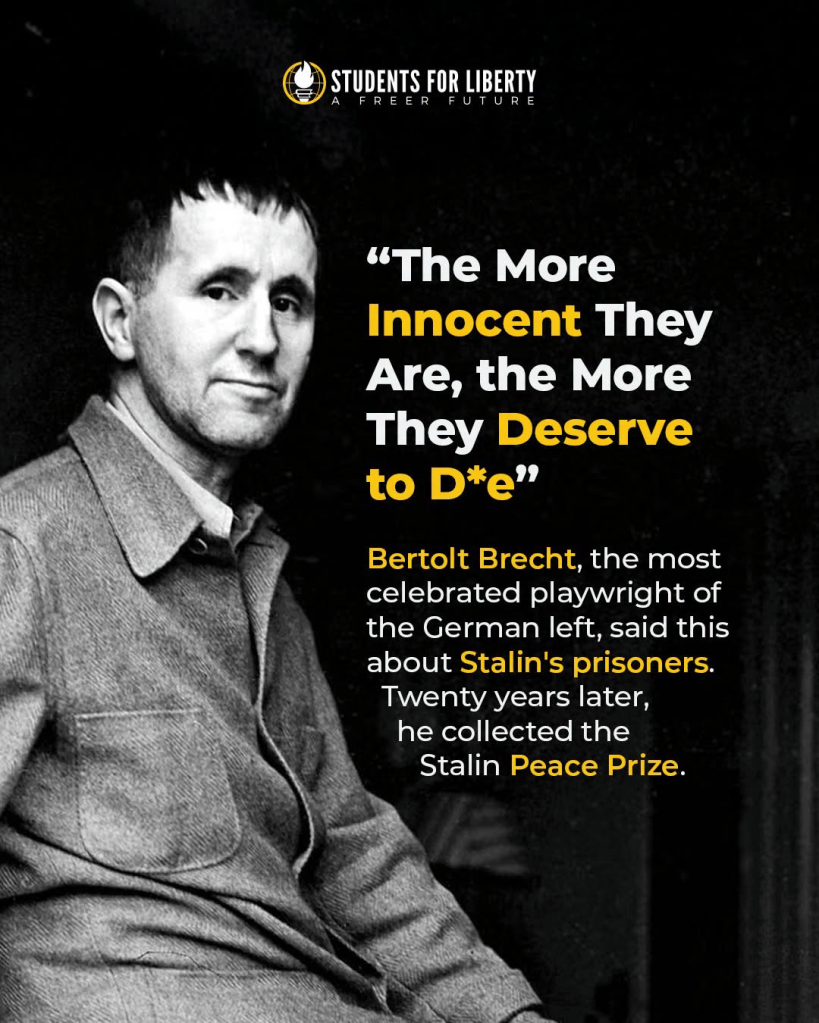
“As for those, the more innocent they are, the more they deserve to d*e.”
Hook asked what he meant. Brecht said nothing. Hook went to the next room, came back with Brecht’s hat and coat, and handed them over. Neither man spoke. Brecht left.
One Witness, One Dissent
Hook published the scene in The New Leader in 1960 and again in his 1987 memoir, Out of Step. He is the only witness. Eric Bentley, Brecht’s leading American champion, disputed it. The historian Henry Pachter said Brecht had made similar remarks in front of him.
What follows is on the record.
His Leading Lady
Carola Neher played Polly Peachum in the 1931 film of The Threepenny Opera. Paul Johnson describes her as Brecht’s former lover. In 1934 she moved to Moscow with her husband, Anatol Becker.
The secret police arrested her in July 1936. Becker was shot. She got ten years.
“There Must Have Been Substantial Evidence”
That was Brecht’s verdict on her conviction, as recorded by his biographer Ronald Hayman and quoted by Johnson.
He did write letters asking friends close to Moscow to intervene. They went unanswered. In public, he said nothing.
Neher died of typhus in a camp near Orenburg on June 26, 1942. She was 41. Her son grew up in a Soviet children’s home, never told what had happened to his parents.
Others Went to Prison. Brecht Went to Europe.
In October 1947, before the House Un-American Activities Committee, Brecht was asked whether he had ever been a member of the Communist Party. “I am a guest in this country,” he said. “I was not a member, or am not a member, of any Communist party.”
The committee thanked him for cooperating. Ten Hollywood writers and directors called the same month refused to answer that question. All ten went to prison. Brecht flew to Europe the next day.
Tanks for the Workers, Loyalty for the Party
In June of 1953, East German workers struck against higher work quotas, and Soviet tanks put the uprising down. On the day of the uprising, Brecht, known as the working class playwright, wrote to party boss Walter Ulbricht:
“At this moment I must assure you of my allegiance.”
The regime had given Brecht his own company, the Berliner Ensemble, and in 1954 a theater to house it. That December, the Soviet Union named him a laureate of the International Stalin Prize for Strengthening Peace Among Peoples.
On May 25, 1955, he collected it in Moscow.
Brecht spent his career showing the powerful crushing the weak. When the powerful man was Stalin, Brecht took his side, then his prize.
Paul Johnson’s Intellectuals (1988) has a name for this: “the heartless tyranny of ideas.” Brecht put a cause ahead of the people it cost, his friend included.
A writer who spent his life siding with the powerless sided with the powerful when it counted. Great work doesn’t make its author good, and an idea is only as good as what it does to real people.
Students For Liberty trains young people to judge ideas by that standard.


Leave a Reply