
Posted on by Robert Jensen
by Robert Jensen
After finishing required coursework, Ph.D. students in most disciplines take preliminary (sometimes called qualifying) exams to demonstrate that they’re ready to begin independent dissertation research. Faculty members on a student’s exam committee sometimes discuss potential questions ahead of time with students.
As a joke, I would tell graduate students in the School of Journalism at the University of Texas at Austin that my question would be simple: “Social science is neither social nor science. Discuss.”
I never asked a student to respond to that prompt, which could have made for a tense exam because not all faculty would find it funny. It was just my way of poking at academics, who seemed to me to be disproportionately socially awkward. More importantly, I wanted students to question whether disciplines such as economics, political science, sociology, and communication studies were sciences in any meaningful sense.
As I’ve gotten older, I’ve realized that I may have been too cynical about the social part of the joke. The larger my sample size—as the number of people I have met in my life grows—the more it seems to me that awkwardness in people is more or less equally distributed among vocations. But I hold firm on the refusal to treat the study of economic, political, and social systems as sciences—not because those fields are less important than physics and chemistry but because they take on vastly more complex subjects that constrain the application of the scientific method. Studying atoms and molecules is hard, but understanding people and societies is more challenging, and often beyond the reach of the methods of contemporary science.
In the natural sciences, it’s possible to discover laws—descriptions of universals such as the laws of motion, gravitation, and thermodynamics. A scientific law identifies regularities in the physical world, describing phenomena or events that always happen in a certain way under specific conditions, allowing us to understand how seemingly disparate things in space and time behave. Scientific theories are well-substantiated explanations of aspects of the physical world that provide a framework for understanding these regularities in observed phenomena. Science can offer universal explanations (at least for the known universe) that allow accurate predictions.
That’s a simple account, of course, and there’s much to explore about how scientific paradigms shift, how theories are discarded when they prove inadequate, and how all of this is very much a social process in which individuals and institutions can (and often do) fail to uphold the rigorous standards of science.
But whatever the failings of science and scientists, scholars working in the social sciences cannot produce anything like laws and theories. This doesn’t mean social scientists are failures, only that they lack some of the tools of the natural sciences. For example, we can’t do experiments on human beings with the same freedom as experiments on atoms and molecules. More accurately, we shouldn’t do certain kinds of experiments on people; the Nazi doctors in Germany and the “Tuskegee Study of Untreated Syphilis in the Negro Male” in the United States remind us of what happens when scientific pursuits are tainted by ideologies such as antisemitism and racism.
Natural scientists also have an advantage in being better able to isolate aspects of reality for study through the method of reductionism—we can learn about complex systems by understanding the behavior of their parts, which allows us to greatly expand our knowledge and manipulate the world. But a cautionary note is necessary: The knowledge produced by reductionism is by definition always partial, and reassembling the parts into an accurate account of a complex system isn’t guaranteed. We often are unable to grasp the patterns in that larger undifferentiated whole. (My favorite quip about reductionism’s limits comes from philosopher Bruce Wright: “The universe is an undifferentiated whole. About that we can say nothing more.”)
Reductionism doesn’t automatically produce irrefutable truth, and our interventions based on incomplete knowledge often turn out to be calamitous. A frightening example is the large number of chemicals synthesized in the past century that have been released into ecosystems with little or no testing to determine their direct effects on organisms, let alone the potential effects when they interact with other chemicals. Because our tissues have no evolutionary experience with these chemicals, the common claim that they are safe is a statement of faith, not fact.
But the limitations and failures of natural scientists shouldn’t obscure the greater limitations on social scientists. A theory of history is no more than an educated guess about how human societies change, or don’t change. A friend who studies political revolutions once told me that every theory of revolution ends up being disproved by the next revolution. There aren’t, and never will be, any laws of economics that are universalizable or have any predictive power. As the old joke goes, economists successfully predicted nine of the last five recessions. (Footnote: That joke evolved from economist Paul Samuelson’s 1962 observation about stock indexes: “Wall Street indexes predicted nine out of the last five recessions!”) Predictive failure doesn’t mean there is no value to economic theory, only that it isn’t science.
My favorite joke about economists comes from my friend Wes Jackson. Before starting a speech to a group of economists, Wes reflected on the category of “shade-tree mechanics,” a term once commonly used to describe folks who repaired cars at home and tinkered with gadgets of all kinds. Wes pointed out that at one point in U.S. history, a lot of shade-tree mechanics were trying to invent a perpetual-motion machine, a device that could do work indefinitely without an external energy source. It’s a great idea, but unfortunately such a machine would violate the laws of thermodynamics.
“I’ve always wondered what happened to those shade-tree mechanics,” Wes said. “Well, it turns out they put on suits and became economists.” He reported that the audience of economists wasn’t amused by the suggestion that conventional economics was based on illusions about unlimited growth on a finite planet.
If it seems like I’m picking on economists, they’ve earned it by being the social science that is most delusional about its pseudo-science claims. In recent decades, political science has been a close second, followed by psychology and sociology. Even history and other disciplines rooted in the liberal arts and humanities can play the we’re-kind-of-a-science game, usually by running statistical analyses of data they can only pretend was collected scientifically. There’s nothing wrong with striving for rigorous data collection or using statistics, but all these disciplines are highly ideological—that is, all along the research road they require judgments that invariably reflect researchers’ assumptions and values. I don’t mean that they are ideological because I disagree with a particular embedded ideology, but because there’s no escaping those judgments in defining terms, collecting data, and building models.
Social scientists don’t have to pretend to be scientists to do important work. Deepening our understanding of human psychology and societies has many benefits, so long as we don’t overdrive our intellectual headlights. Even without the kinds of laws and theories produced in the natural sciences, scholars can work to identify patterns in human behavior.
Pattern perception is one of the things human beings do quite well. Our evolutionary success is in part a product of being able to understand the patterns around us and come to relatively reliable judgments about how to respond. We could (and still can) recognize patterns in how predators move through tall grass, or where certain plants grow in certain landscapes, or animals’ migration habits. This helped gathering/hunting humans (the economic system for more than 95 percent of our species’ evolutionary history) stay alive and find food. Our economic systems have changed, but our pattern-perception abilities remain.
Identifying patterns in human behavior can help us create practices and institutions that are adapted to local places and that can enhance human flourishing. The fact that so many of today’s institutions degrade ecosystems and inhibit human flourishing reminds us that people pursuing power, wealth, ideological purity, or theological righteousness can put those pattern-perception skills to work serving other goals.
That’s an ecumenical statement meant to apply broadly. I’ve worked in government, small businesses, corporations, and both private and public universities—run by people from the right, left, and center—and have seen both the positive and negative aspects of all those institutions and the people who run them. But our failures don’t negate our capacities and should remind us of the importance of doing intellectual work with integrity.
[This essay is adapted from This I Don’t Believe: A Fulfilling Life without Meaning.]
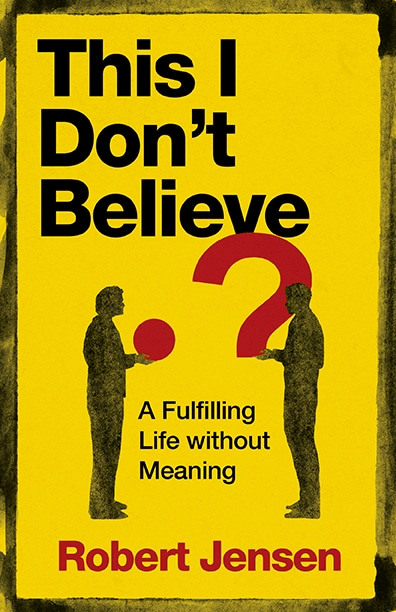
This I Don’t Believe confronts the common fear that life has no intrinsic meaning, then describes one path to fulfillment without it. Mixing memoir and philosophy, Robert Jensen invites readers to ponder the possibility of life without transcendence. Rejecting common sources of meaning—belief in God, spirituality, Nature mysticism, and free will—need not leave us stuck with nihilism. Drawing on his work as a journalist and professor, Jensen suggests that a life of thinking and work—joyful inquiry into a wonderfully complex world, coupled with a practice of ordinary labor—is enough to create a fulfilling life.
Philosophy is often impersonal and abstruse, intellectually dense and abstract. This I Don’t Believe is deeply personal and practical. Starting with an account of a broken childhood, Jensen explains how he built a worldview that doesn’t look away from the harshness of the world, yet isn’t suffocated by it. The book offers a jargon-free tour through contemporary philosophy and politics, encouraging readers to reflect on their own choices and commitments.
Rather than simply rehashing well-known theological and philosophical arguments, This I Don’t Believe makes a case for:
- resisting the temptation to answer questions to which we cannot know the answers;
- accepting the limits of human understanding and learning to be comfortable with not-knowing;
- recognizing how little we understand not just about the world but about ourselves; and
- finding joy in everyday activities without assigning deeper meaning to them.
Endorsements:
“Robert Jensen’s prose is like water—simple, refreshing, nourishing. The author refuses to tell anyone what to think, but shows how life’s sharp twists brought one man to think. A profound and delightful book.”
–Elizabeth Cobbs, historian and author of Liberated: A Memoir
“If Socrates had been born an American in the 20th century, this is a book he would have written. There is nothing Robert Jensen is afraid to question and no answer he is afraid to consider. Read it at your peril!”
–Patrick Curry, author of Ecological Ethics and editor-in-chief of The Ecological Citizen
An ode to critical thinking, this personal, intelligent, and engrossing work connecting a constellation of ideas is a truly enjoyable read. There’s comfort in finding meaning in big ideas. God, the soul, free will can help one feel loved, special, in control. Jensen finds these sources of meaning hollow, requiring a faith that doesn’t blend well with critical thought. Jensen traces the roots of his perspective to his traumatic childhood, hazily remembered, which imposed on him a need for self-reliance. This start in life fuels his hesitancy to rely on faith or ideas bigger than himself. This book delivers a roadmap to finding satisfaction and fulfillment in life through critical and rational engagement with the world around us.”
–Josh Cannon, University of Pittsburgh, author of Fatal Second Helen: A Modern Veteran’s Iliad
“You can give up God, spirit, Nature, and free will; accept that most of reality is permanently beyond us; and still wake up early, do your work, walk the dogs, and find that enough.”
–Samir Varma, author of The Science of Free Will
“In this personal and engaging book, Robert Jensen manages something that doesn’t always come easy to skeptics or rationalists: treating alternative beliefs with respect and openness. Jensen presents his views in a reflective and modest way, while remaining clear throughout about what he doesn’t believe and why. What is left in the absence of transcendent meaning? What is achievable in a world without God, spirituality, ‘Nature,’ or free will? Jensen makes a convincing case for a fulfilling life of working and thinking, balanced by warnings about the ‘temptations of dense energy.’ Come for the atheism; stay for the wisdom.”
–Jeroen Bouterse, founder of history of science blog Shells and Pebbles
Robert Jensen, an Emeritus Professor in the School of Journalism and Media at the University of Texas at Austin, is the author of a dozen books on politics and culture. Mor


Leave a Reply